The forgotten coin that became a Filipino expression.
You have probably heard someone say it after payday money disappears, a wallet turns up empty, or a debt collector comes knocking: “Wala na akong kahit isang kusing.”
Today, kusing simply sounds like an old-fashioned word for money—usually used to emphasize that someone has absolutely nothing left.
But the expression carries a surprising piece of Philippine monetary history.
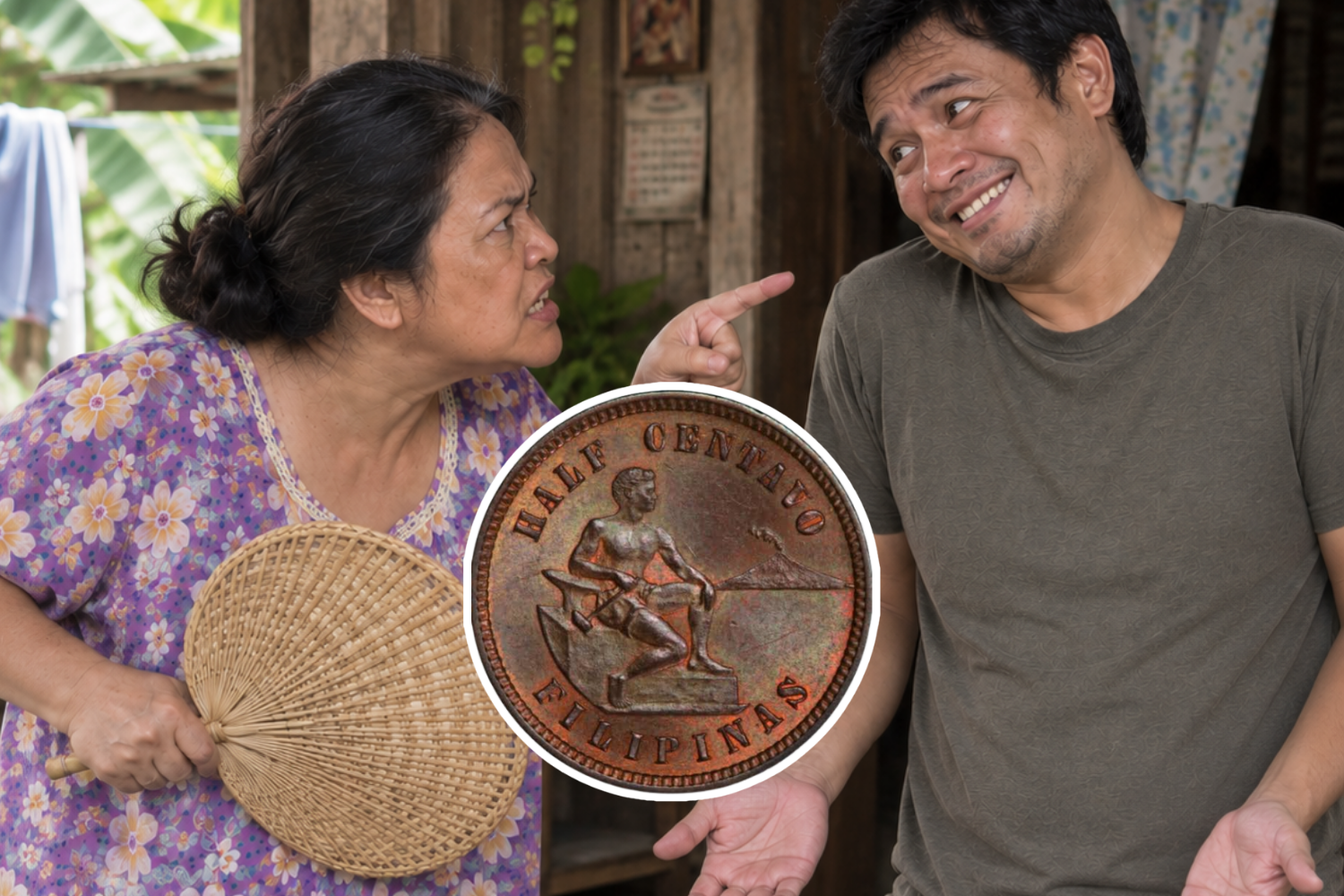
A kusing was once associated with the half-centavo, an extraordinarily tiny denomination worth just ₱0.005—or half of one centavo. It was so small that its disappearance from circulation helped turn its name into a lasting metaphor for being completely broke.
Even the word itself has an interesting story.
Kusing is believed to have developed from singko, derived from the Spanish cinco, meaning five. Through the kind of syllable-switching or metathesis that has long appeared in Filipino wordplay, sing-ko became ko-sing, eventually evolving into kusing.
The coin associated with the term became particularly notable during the American colonial period.
Under the Philippine Coinage Act of 1903, a new monetary system was introduced for the islands, with the peso fixed at two pesos to one US dollar. Among the denominations produced was the bronze half-centavo coin, struck by the US Mint in Philadelphia in 1903 and 1904.
On one side was a seated Filipino man holding a hammer beside an anvil, with the smoking Mayon Volcano in the background—imagery meant to represent labor and industry.
There was just one problem: people reportedly had little use for such a tiny denomination.
Production stopped after 1904, and the half-centavo was eventually withdrawn. In 1908, the denomination was officially discontinued, with remaining coins recalled and melted down.
But while the coin disappeared, the kusing survived.
Over generations, “kahit isang kusing” became shorthand for the smallest imaginable amount of money. To say “wala kahit isang kusing” was therefore stronger than simply saying you had little money.
You did not even have the smallest coin.
More than a century later, Filipinos may no longer carry a kusing in their pockets—but we still know exactly what it means when there isn’t one left.
READ: