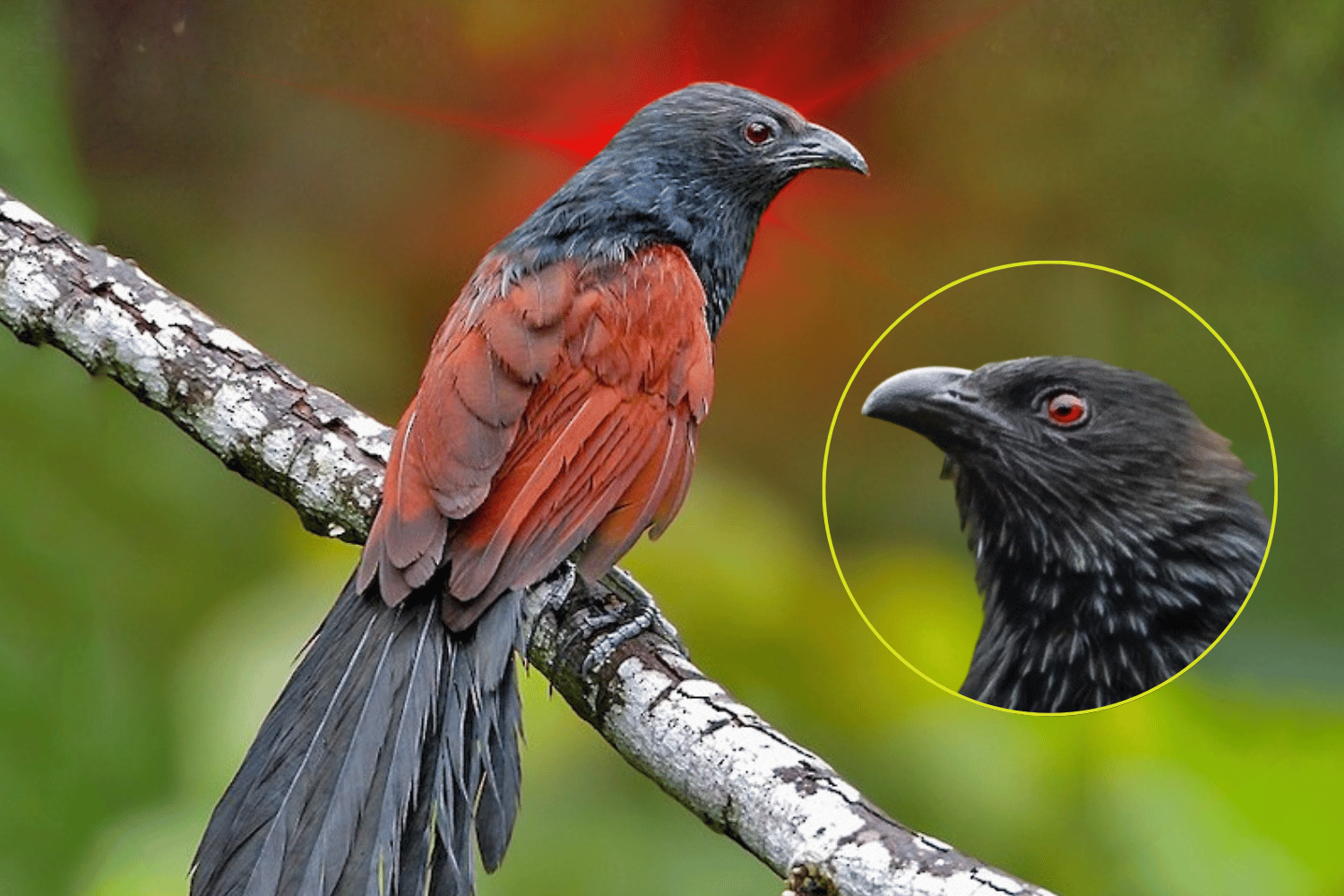
The Philippine coucal has long been linked to death, sickness and bad luck.
You hear a low, haunting “kok-kok-kok” somewhere behind the house.
Then a large black bird emerges from the vegetation. It has a long tail, chestnut wings, a heavy curved bill—and a pair of startling red eyes.
For generations of Filipinos, that combination was enough to inspire fear.
The Philippine coucal (Centropus viridis) has been associated in local folklore with death, sickness, misfortune and even the supernatural. In some communities, hearing its strange call near a home could be interpreted as a warning that something terrible was coming.
But science tells a very different story.
The supposedly “demonic” bird is simply one of the Philippines’ distinctive endemic species—and many of the characteristics that made people fear it are perfectly ordinary parts of its biology.
The creepy call is just a bird talking
Depending on where you live, you may know the Philippine coucal as kokok, sabukot, sabuko, saguksuk or siakok.
Several of these names imitate its unmistakable voice: a series of deep, resonant notes that can sound eerie when coming from thick vegetation, particularly in the early morning or during gloomy weather.
But the coucal isn’t announcing somebody’s death.
Like other birds, coucals vocalize to communicate, including establishing territory and interacting with mates. The mysterious sound coming from the bushes is bird language—not a supernatural warning.
Those red eyes aren’t demonic
Its appearance probably didn’t help its reputation.
The Philippine coucal is a striking bird with glossy dark plumage, rich chestnut wings, a long tail and conspicuous reddish eyes.
To generations raised on stories connecting unusual animals with the supernatural, those eyes could easily become symbols of something sinister.
Biologically, however, eye color is simply a physical characteristic. Red or reddish irises occur naturally among various bird species. There is no scientific evidence connecting the coucal’s eye color with illness, death or bad luck.
No, it isn’t an evil cannibal
Another sinister reputation attached to the bird involves its diet.
Philippine coucals are predators, but their prey includes insects and other small animals such as lizards and amphibians. By eating insects and other creatures around farms, gardens and vegetation, they are simply occupying their natural place in the ecosystem.
And despite belonging to the cuckoo family, the Philippine coucal does not practice the infamous reproductive strategy associated with some cuckoos.
It doesn’t normally dump its eggs into another bird’s nest and leave strangers to raise its offspring. Coucals build nests and care for their own young.
A bird we should be proud of, not afraid of
Perhaps the greatest irony is that Filipinos have spent generations fearing an animal that is uniquely ours.
The Philippine coucal is endemic to the Philippines, occurring across much of the archipelago. It is a large, beautiful and unmistakably tropical bird that evolved as part of the country’s extraordinary biodiversity.
Its reputation as a messenger of death says more about human imagination than it does about the animal.
Before modern biology could explain animal behavior, an unfamiliar cry in the darkness, glowing-looking red eyes or a shadow moving through thick vegetation could easily become the beginning of a frightening story. Passed from one generation to another, those stories eventually became beliefs.
But folklore should not become a death sentence for wildlife.
The next time a kokok calls somewhere outside your window, there is no reason to panic or expect tragedy.
There is probably just a Philippine coucal nearby—calling, hunting, looking for a mate and living the ordinary life of a bird that Filipinos have made frightening only because we never really understood it.
READ:
The CIA once turned the Filipino aswang into a weapon of war
Top Dagohoy
July 26, 2026
The bird you call ‘maya’ is an impostor
Top Dagohoy
August 4, 2026

The Spanish used fear of the tiktik to demonize the babaylans
Top Dagohoy
August 9, 2026