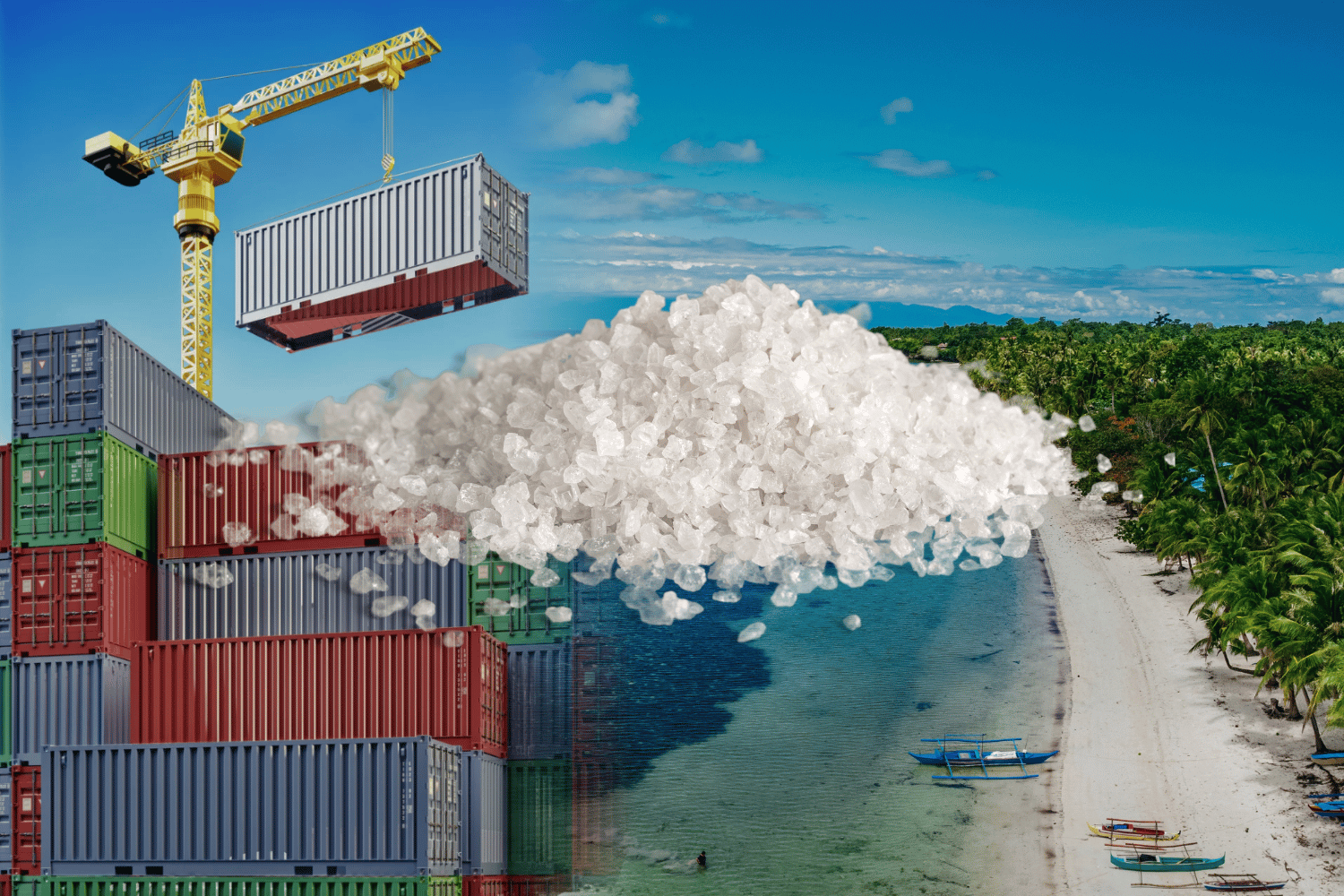
The Philippines imports about 93% of its salt supply despite its vast coastline, as the government pushes to revive local salt production.
The Philippines is an archipelago surrounded by seawater, yet most of the salt used by Filipino households and businesses still comes from abroad.
The country’s estimated annual salt requirement is 683,000 metric tons, with about 93% supplied by imports, according to BFAR, citing NFRDI.
That is a striking imbalance for a country with thousands of kilometers of coastline, but producing salt locally is more complicated than simply having seawater available.
Local salt producers have had to contend with imported competition, changing land use, weather-related production problems and the cost of meeting production and food-safety requirements.
The 1995 ASIN Law, which requires food-grade salt to be iodized, also created additional equipment and compliance requirements for producers. The law itself provided for government assistance to help local salt makers adopt iodization technology, while studies have since pointed to implementation challenges among smaller producers.
A recent PIA report offers a look at one community trying to build local production again. In Daram, Samar, the Daram Association of Fish and Squid Processors is producing salt through solar evaporation and selling it for ₱20 per kilogram to nearby processors.
The project gives the association another source of income while providing a locally produced input for fish processing.
Daram is a small operation, but it comes as the government is trying to rebuild an industry that has become heavily dependent on imports.
The Philippine Salt Industry Development Plan 2025–2040 calls for modernizing production, expanding salt-producing areas and improving market access, while RA 11985, or Philippine Salt Industry Development Act, provides for technology, financing, production and marketing support for the sector.
BFAR has also been providing equipment and technical assistance to salt producers in different parts of the country.
The government is now trying to rebuild the industry through equipment, technical assistance and a 2025–2040 development plan. The hope is that these efforts can help local salt production grow beyond small community projects and become a dependable commercial industry.
Daram shows that the raw material is hardly the problem. The country has seawater in abundance. What has been missing is the ability to turn that resource into enough locally produced salt, at the right cost and quality, to compete with what is already coming in from abroad.
READ: