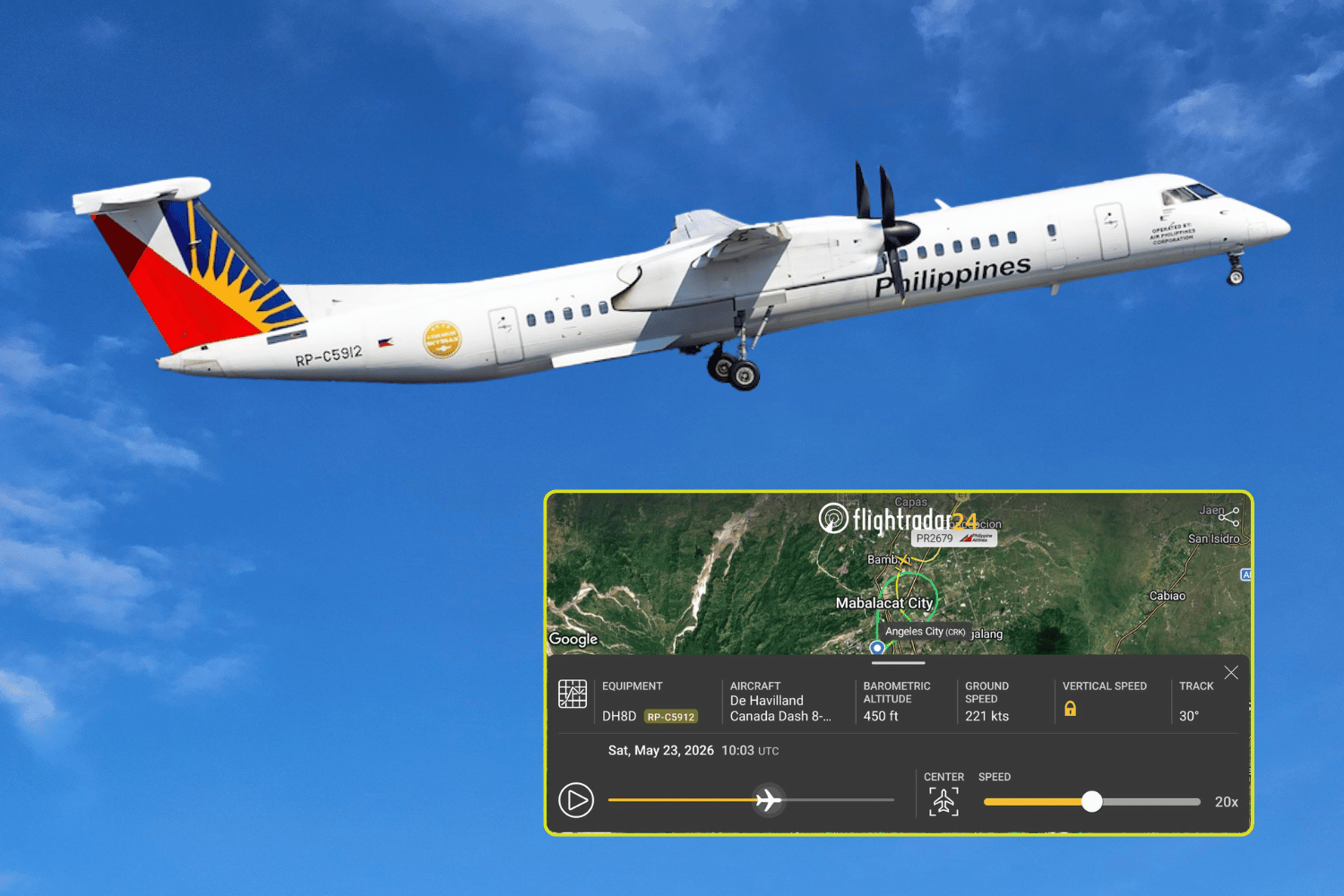
Deployed on a standard regional route from Busuanga to Clark, the PAL Flight PR2679 encountered microclimatic wind shear during its final approach last May 23, forcing the flight crew to execute a textbook missed approach and divert safely to Manila—proving that despite alarming, unverified interpretations of crowdsourced flight-tracking apps online, the carrier's strict safety protocols performed exactly as engineered.
The flight encountered wind shear, executed a missed approach, and diverted safely to Manila.
The flight from Busuanga to Clark on May 23 encountered windshear during final approach, prompting pilots to carry out a standard missed approach procedure in line with safety protocols, PAL said.
The aircraft did not complete its landing at Clark and later diverted to Manila due to continuing adverse weather in the area. It landed safely, with passengers assisted upon arrival.
Dismantling the Flightradar24 panic
Online discussions were fueled by Flightradar24 flight-tracking screenshots that appeared to show sharp changes in altitude and speed during the maneuver. PAL said the aircraft’s rates of ascent and descent were consistent with windshear avoidance and recovery procedures under the prevailing conditions.
“The crew remained in full control of the aircraft at all times,” the airline said in a statement, adding that conclusions based solely on publicly available flight-tracking data do not provide a complete or authoritative account of the aircraft’s performance or weather conditions at the time.
The incident prompted discussion on social media, with aviation observers noting that ADS-B and flight-tracking data can sometimes produce misleading readings during low-altitude maneuvers and adverse weather.
PAL said it is conducting a review of the incident and will submit findings to the appropriate authorities.
Crowdsourced radar maps don’t tell the full story. Philippine Airlines corrects viral flight-tracking claims over a routine Clark diversion.
radar Recommends
Understanding aviation safety and telemetry protocols
Treat crowdsourced flight-tracking platforms strictly as general reference tools, not as definitive legal or technical evidence. Real-time data feeds are highly susceptible to packet dropouts, atmospheric signal distortion, and localized radar positioning lag during heavy storm cells. If a flight path appears erratic or shows sudden speed drops on your mobile screen during a storm, wait for the airline's official dispatch feed or port authority log before jumping to conclusions.
Understand that a "go-around" is an active proof of safety culture. If your commercial flight suddenly applies maximum engine power and climbs steeply away from the runway right before landing, do not panic. This maneuver is known as a go-around or missed approach. It is a standard, highly rehearsed safety protocol triggered whenever visibility drops, wind vectors shift unexpectedly, or a previous aircraft fails to clear the runway in time. It indicates that your flight crew is actively managing risks rather than forcing a hazardous landing.
As radar’s business editor, Kenneth oversees stories on innovation, enterprise, and business trends. Off the clock, you’ll find him jamming to Mariah Carey, logging miles on a run, or diving for a volleyball.