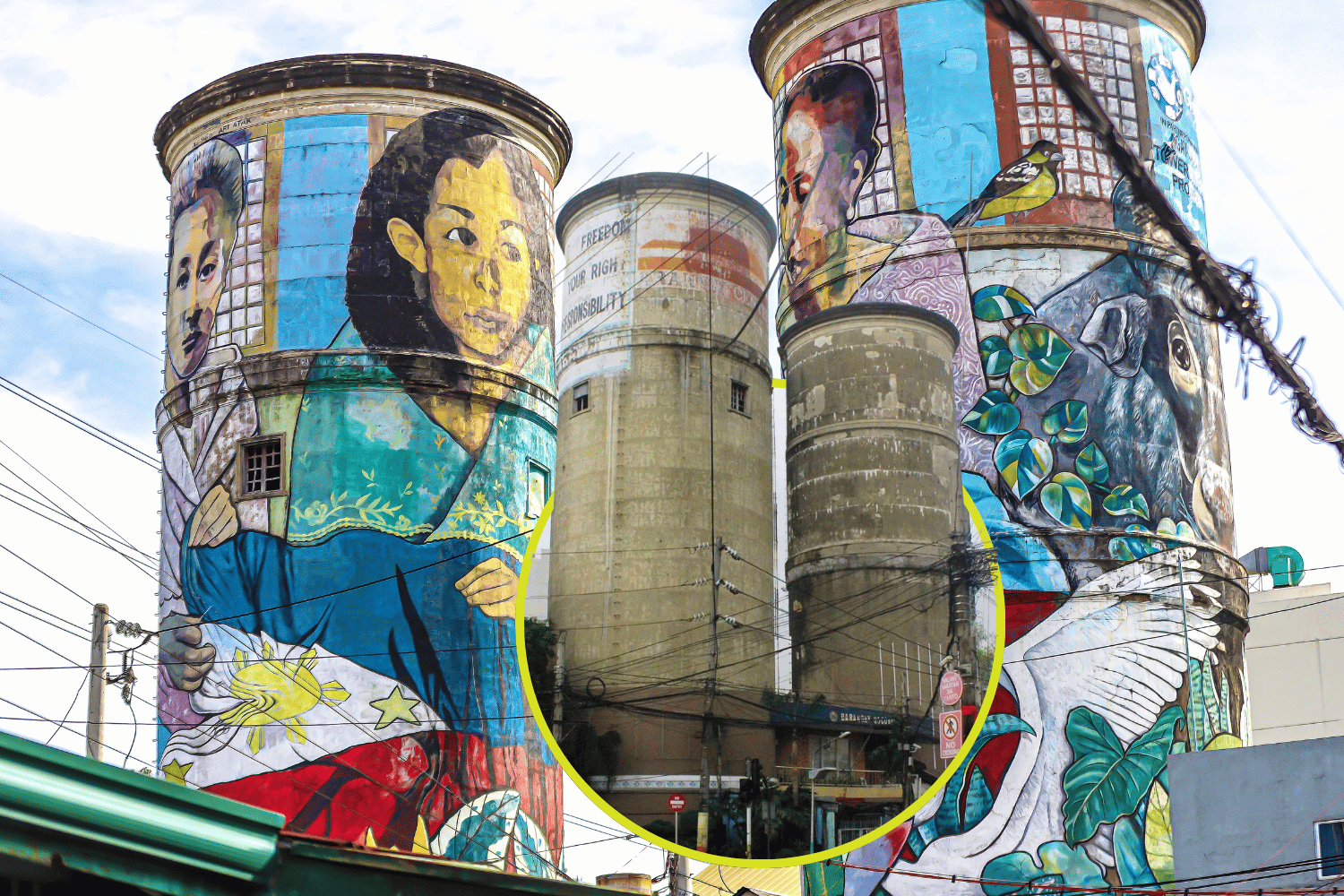
The Socorro Water Towers were built in the late 1930s during the American colonial period.
Every day, thousands of commuters pass through Cubao. Jeepneys roar by, buses crawl through traffic, and pedestrians hurry across busy intersections. Amid the urban rush stand two giant concrete towers that have quietly watched the city change for nearly a century.
Many have wondered what they are. Are they abandoned buildings? Military structures? Forgotten watchtowers? Few realize these towering landmarks are among Quezon City’s oldest surviving pre-war structures—and silent witnesses to some of the country’s most significant moments.
Known officially as the Socorro Water Towers, they were built in the late 1930s during the American colonial period to provide clean drinking water to the then-growing Cubao community. Although commonly referred to as twin towers, they were actually constructed about a year apart, with the newer one built slightly smaller than the older structure.
The towers survived the Battle of Manila in 1945, when much of the capital was devastated by artillery fire and aerial bombardment during the liberation of the Philippines. After the country gained independence in 1946, the facility was turned over to the National Waterworks and Sewerage Authority (NAWASA), now the Metropolitan Waterworks and Sewerage System (MWSS). By the late 1950s, the towers had become non-operational, ending their relatively brief service as Cubao’s water supply.
Their story, however, did not end there.
During the December 1989 coup attempt against President Corazon Aquino, one of the towers sustained two holes after being struck by flying projectiles because of its proximity to Camp Aguinaldo. The damage was later repaired, adding another chapter to the landmark’s remarkable history.
Instead of being demolished, the towers found a new purpose at the heart of the community.
Today, the base of one tower houses Barangay Socorro’s primary healthcare clinic, while the other serves as offices for the barangay tanods and the Gender and Development (GAD) program. Between and behind the towers stand the barangay hall, a daycare center, and a covered basketball court, making the historic compound an active center of public service.
Residents have grown so attached to the landmark that many simply say, “Punta tayo sa tanks,” instead of “Punta tayo sa barangay hall.”
The aging towers have also become giant canvases for history. Their exteriors now feature murals of Marcela Agoncillo, her daughter Lorenza, and Delfina Herbosa de Natividad—the three women who hand-sewed the first Philippine flag in 1898. Protective canopies have likewise been installed around the site after small pieces of concrete occasionally detached from the aging structures.
For countless motorists, commuters, and train passengers, the Socorro Water Towers remain mysterious concrete giants on the roadside.
Behind their weathered walls, however, lies nearly 90 years of Philippine history—a reminder that some of the country’s most fascinating landmarks aren’t found inside museums. Sometimes, they’re hiding in plain sight, waiting for someone to finally ask, “Ano nga ba talaga ’yan?”
READ: