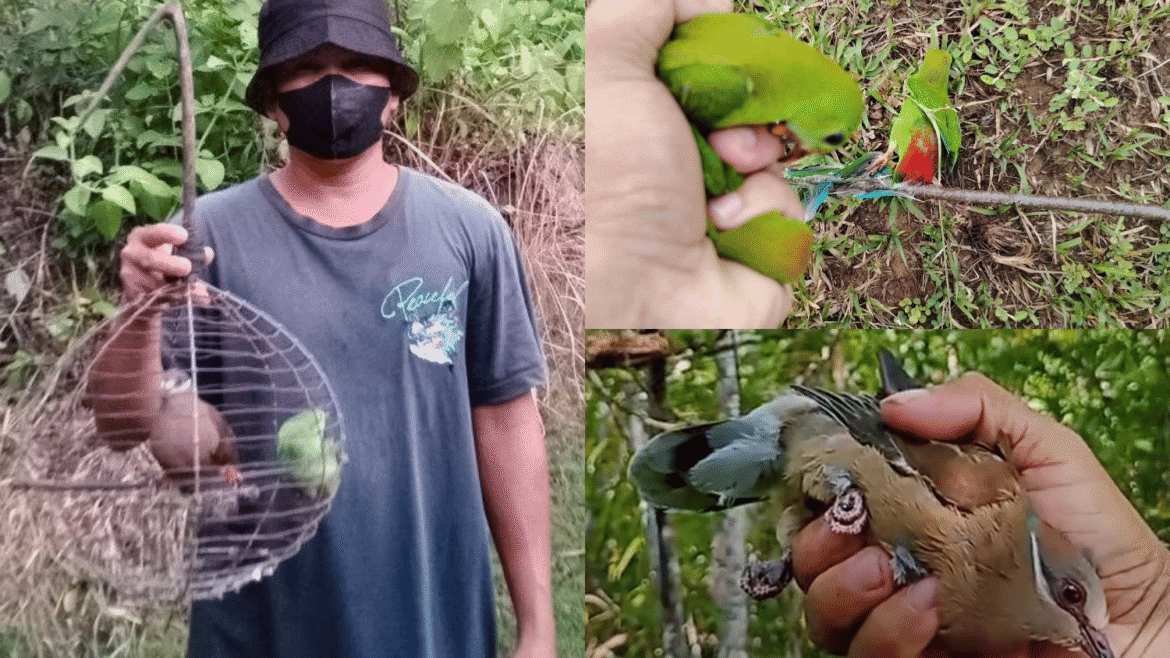
If this is the DENR’s idea of enforcement, then a wildlife protection law with criminal penalties is useless.
Secret Hunter wasn’t exactly keeping his hunting activities secret.
Since the Bohol-based content creator launched his Facebook page in March 2025, he has been documenting his latest “hauls”: bawod, kulasisi, alimukon, and other birds captured by bare hands, kept in cages, and turned into content for 14,000 followers.
Wildlife advocates, including Romblon Wildlife • Lloyd Fabrigar, eventually called attention to the posts—and urged the Department of Environment and Natural Resources to take action.
radar did its journalistic duty to expose the page and amplify calls to investigate the apparent illegal activity on Sept. 4.
A day later, Secret Hunter posted a video saying the DENR went to his home. And for what? To give a warning, that is.
“Pinuntahan na tayo ng taga-DENR,” the content creator said. “Lahat ng mga alaga natin na kulasisi, wala na, pinakawalan na. Kung naghahunting kayo ng kulasisi, itigil n’yo na ’yan… kasi bawal daw.”
That’s about it.
However, that shouldn’t be the case. The evidence of wrongdoing was given to DENR for free. It was handed on a silver platter.
Under Section 27(f) of Republic Act No. 9147, or the Wildlife Resources Conservation and Protection Act, it’s illegal to “collect, hunt or possess wildlife, their by-products and derivatives.”
Section 23 is even more specific on threatened species: their collection “shall be allowed only for scientific, or breeding or propagation purposes.” Even then, conservation breeding or propagation may be done only by “accredited individuals, businesses, research, educational, or scientific entities.” Section 6 further requires DENR to authorize such activities only after evaluating scientific information showing they won’t be detrimental to the species or its habitat.
And the kulasisi isn’t just another bird. The Philippine hanging parrot (Loriculus philippensis) is classified as critically endangered under DENR Administrative Order No. 2019-09.
If that’s the case, the penalties can be severe. For killing or destroying a critically endangered species, Section 28 of RA 9147 provides for six years and one day to 12 years in prison and/or a fine of ₱100,000 to ₱1 million. For collecting, hunting, or possessing one, the penalty is two years and one day to four years in prison and a fine of ₱30,000 to ₱300,000.
So, how did all of that become a mere warning? If this is the DENR’s idea of enforcement, then a wildlife protection law with criminal penalties is useless.
To be clear, the law has teeth. If the DENR cannot enforce it, the agency risks becoming an enabler of the very poaching it’s supposed to stop.
What the DENR does now is teach poachers exactly how much they can violate the law—and still walk away with nothing more than a warning. What the DENR shows is that it doesn’t give a flying f*ck about our environment.