The game is more likely to appear at school sportsfests, barangay fiestas and cultural programs than as everyday street play.
It’s elementary school sportsfest. Your classmates are screaming from the sidelines as you stand at the starting line—not in running shoes, but on two coconut shells.
You grip the ropes. The teacher gives the signal. Suddenly, everyone is clattering across the school grounds, wobbling, stumbling and desperately trying to stay on their bao.
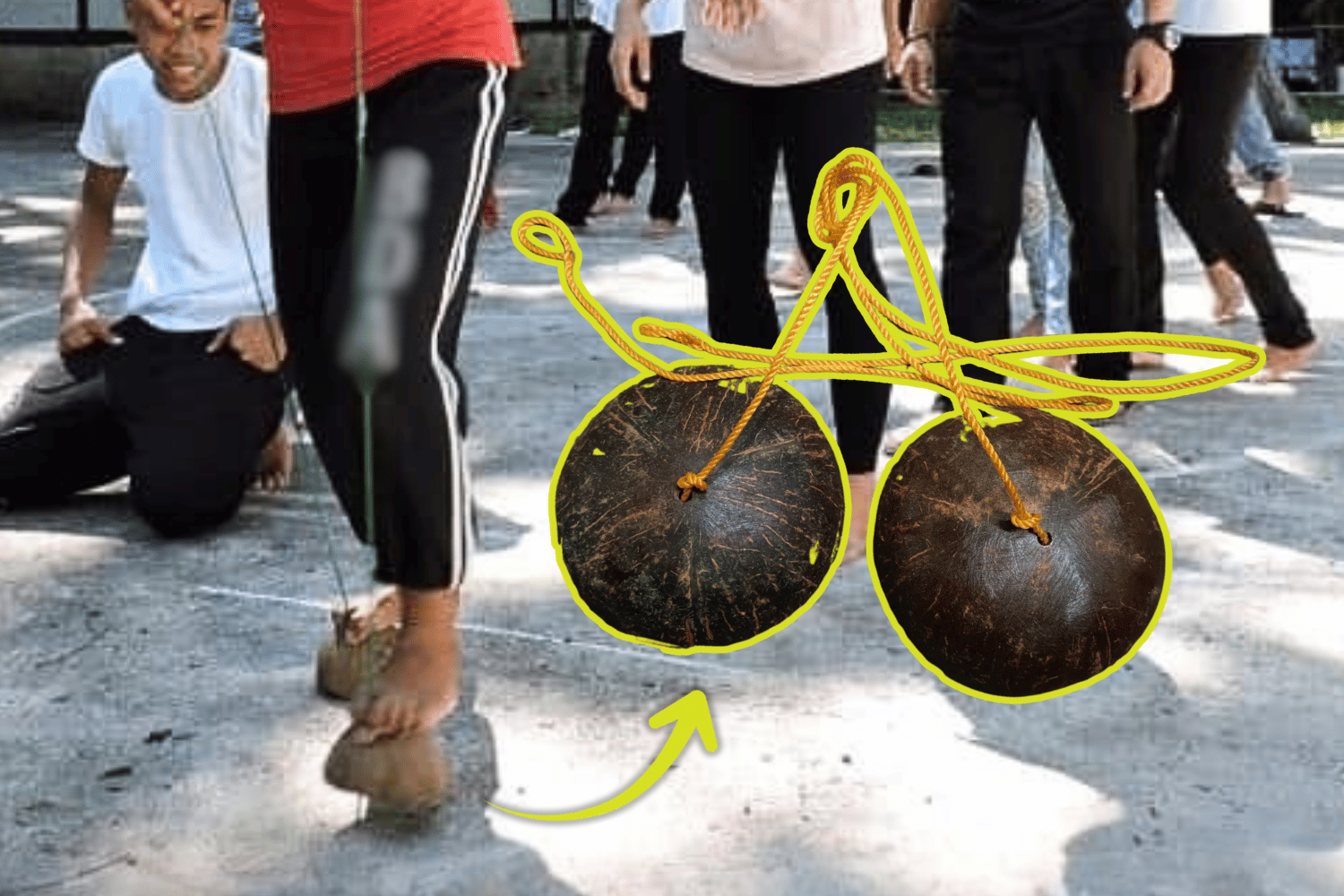
This is kadang-kadang sa bao, one of the simplest and most entertaining Filipino traditional games.
The equipment could hardly be cheaper: two coconut-shell halves and pieces of rope. A hole is made in each bao, the rope is threaded through it, and the player steps on the shells while pulling the strings upward to keep them against the feet.
Then comes the hard part: moving.
Each pull must synchronize with each step. In relay races, players go around a marker and return before passing the stilts to the next teammate. Lose your footing and you climb back on.
From old-fashioned play to laro ng lahi
Kadang-kadang belongs to the Philippines’ long tradition of stilt games. It is related to tiyakan or tiyakan in Tagalog and karang in parts of the Visayas. The better-known tall version uses bamboo poles, while kadang-kadang sa bao substitutes coconut shells for stilts.
Pinning down exactly when and where Filipino children first played it is difficult. Like many folk games, it was passed from one generation to another rather than invented by a documented individual. Its materials, however, reveal much about its roots: in coconut-growing communities, discarded bao and inexpensive rope could easily become toys.
Traditional Filipino games eventually became collectively promoted as laro ng lahi, helping bring games once played informally in streets and backyards into schools, fiestas and organized cultural activities.
More than just a race
Kadang-kadang quietly trains balance, leg and core strength, and hand-foot coordination. Relay versions add teamwork and strategy.
Today, it is more likely to appear at school sportsfests, barangay fiestas and cultural programs than as everyday street play.
But generations of Filipino children probably never thought of it as cultural preservation.
It was simply a race.
Two bao. Two ropes. A finish line.
And bragging rights if you got there first.
READ: