Decades in the making, the dish has become Tuguegarao’s signature local meal.
Order pancit almost anywhere in the Philippines and you probably know what is coming: noodles tossed with vegetables and meat, perhaps finished with calamansi.
Order one in Tuguegarao City and things get considerably more serious.
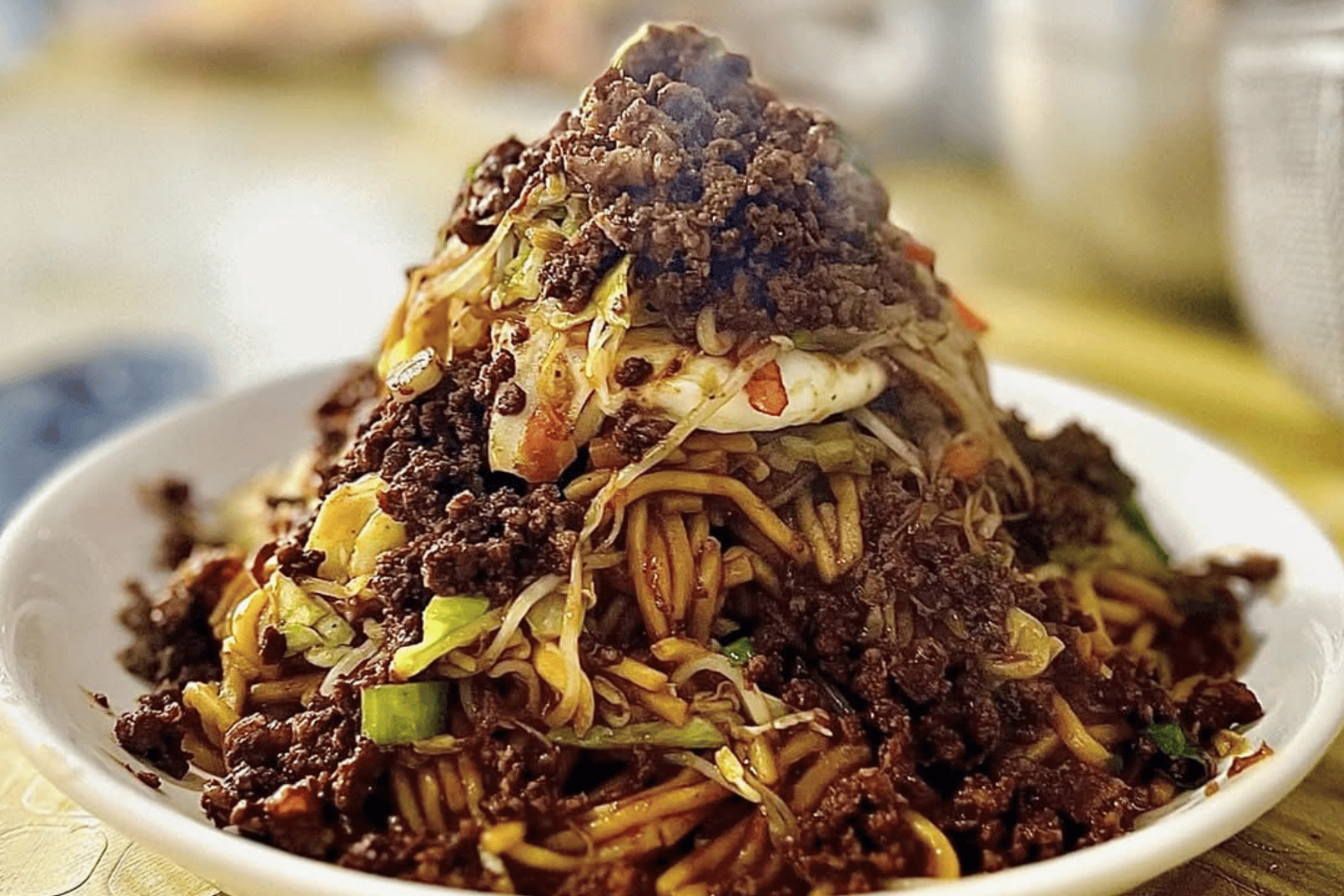
A plate of pancit batil patung can arrive buried beneath ground carabao meat, vegetables and an egg, accompanied by a steaming bowl of egg-drop soup and a potent mixture of chopped raw onions, soy sauce, chili and calamansi.
It is not merely another regional variation of pancit. For generations of Tuguegaraoeños, it has become one of the city’s defining foods.
The name tells you what makes it different
The two words that distinguish the dish describe two of its essential components.
“Batil” refers to the beaten egg incorporated into the accompanying broth, producing the signature egg-drop soup. “Patung,” meanwhile, refers to the egg placed on top of the noodles.
Historical research on the dish shows that this combination was not always standard. In the 1980s, customers could order pancit with batil, with patung, or with both. Eventually, having both became the norm—and “batil-patung” became the name commonly used for the dish itself.
It didn’t always look this extravagant
Like pancit elsewhere in the country, Tuguegarao’s noodle culture carries a strong Chinese influence. But locals transformed it using ingredients and flavors available in Cagayan Valley.
Research on the history of the dish traces the roots of modern batil patung to Tuguegarao’s panciterias in the 1960s. Early versions already featured minced carabao meat and locally made noodles.
By the late 1970s, the dish was moving toward the batil patung recognizable today. Mung bean sprouts became common, while the poached egg that would eventually become the “patung” began appearing as an optional topping.
The separate broth evolved, too. By the 1980s, it had become the recognizable beaten-egg soup now called batil.
By the 1990s and 2000s, “special” and “super special” versions arrived, and panciterias began piling on increasingly elaborate extras.
Today, some versions are practically mountains of food. Chicharon, lechon kawali, pork liver, lumpiang shanghai, chicken skin and chicharon bulaklak have all found their way onto plates around Tuguegarao.
But the classic is surprisingly simple
Strip away the modern excess and traditional batil patung is straightforward: miki noodles, sautéed minced carabao meat and egg, with the steaming batil served alongside it.
That carabao meat, or carabeef, is crucial. It gives the dish a deep, meaty character that separates it from the pork- and chicken-heavy pancit varieties familiar elsewhere in the Philippines.
And then there are the onions.
Raw chopped onions are typically mixed with soy sauce, chili, vinegar or calamansi, providing the sharp acidity and crunch needed to cut through all that meat, egg and noodles.
The batil can be sipped between mouthfuls or poured onto the noodles, depending on the eater.
A pancit city of its own
Tuguegarao remains dotted with panciterias, and there is no single definitive version. That is part of the attraction.
Among the names associated with the dish are Eva’s Pansiteria, Jomar’s Panciteria, Jed’s Panciteria and Alicia’s Pansiteria, each offering its own interpretation and selection of toppings.
But perhaps the best introduction is still the simplest version you can find: hot miki, ground carabeef, egg on top, batil on the side and plenty of onions.
Because beneath all the overloaded versions that came later is a hearty local meal that Tuguegarao spent decades making unmistakably its own.
READ:
Jo-ni’s was once bigger than Goldilocks
Top Dagohoy
September 19, 2026
Real-life panciteria from ‘El Filibusterismo’ still standing—but rotting away
Walter C. Villa
June 3, 2026
Siopao lovers, these five spots are worth the trip
radar Lifestyle
July 26, 2026