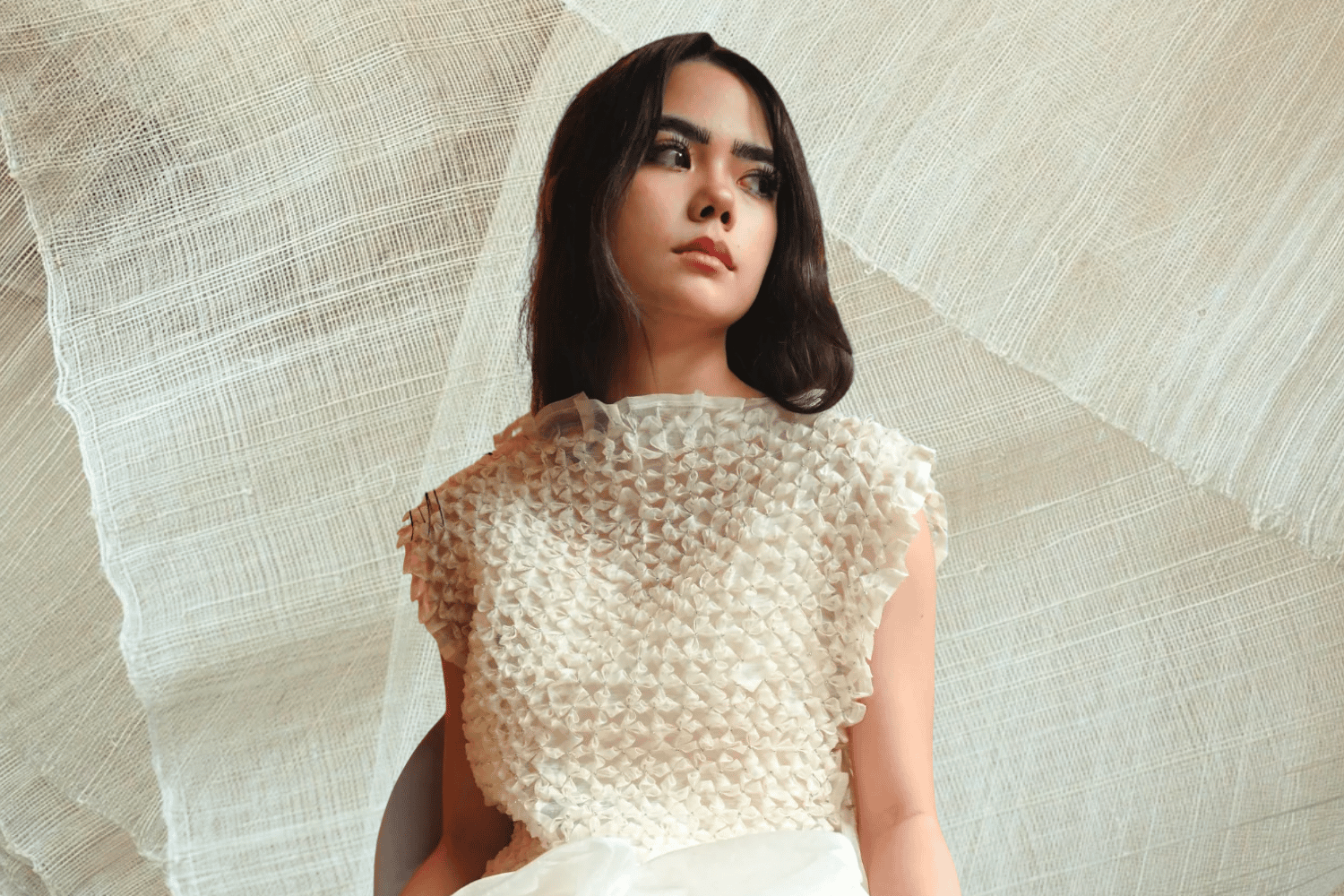
‘In line with the recent discourse on local brands… please educate me on how this top is ₱25k,’ the user wrote.
And people did.
Designers and fashion enthusiasts explained that the price goes beyond the finished blouse. There is the expensive textile, specialized sewing and, in this particular design, extensive hand-smocking.
‘Piña silk is expensive, the fabric manipulation on this top is hard to do,’ one user replied.
Another designer pointed out that hand-smocking consumes considerably more fabric than a flat garment because the material has to be gathered and manipulated repeatedly to create its textured surface.
But why is piña expensive in the first place?
The answer begins long before anyone cuts the fabric.
Authentic Aklan piña is made from fibers extracted from pineapple leaves. The process is painstakingly manual. Artisans scrape the leaves to separate the fibers, with the finest strands eventually becoming the material used for weaving.
The resulting fibers are extremely fine and delicate. They must be cleaned, prepared and individually joined to produce sufficiently long threads before they can even reach the loom.
Then comes weaving.
Piña is traditionally woven by hand, and its delicate fibers demand considerable skill and patience. Threads can snap during weaving and have to be painstakingly reconnected. Production is consequently far removed from the speed of industrial textile manufacturing.
And the labor does not necessarily stop once the cloth is finished.
The ₱25,000 top that triggered the Threads discussion uses smocking—a technique in which fabric is carefully gathered and stitched to create its distinctive three-dimensional texture. Hand-smocking takes time and can require considerably more fabric than a conventional flat top.
‘You are paying for craftsmanship, labour, and Filipino creativity,’ another commenter explained.
Piña weaving is also more than a luxury-fashion technique. In 2023, UNESCO inscribed Aklan piña handloom weaving on the Representative List of the Intangible Cultural Heritage of Humanity, recognizing the knowledge and skills surrounding the textile and their importance to Aklanon communities.
That makes the viral ₱25,000 top part of a much bigger conversation about how Filipinos value handmade work.
Decades of mass-produced fashion have conditioned consumers to see clothing primarily through the price of the finished object. But handmade garments carry costs that are harder to see: hours of skilled labor, specialized knowledge, limited production and techniques passed from one generation to another.
Behind piña are farmers, fiber processors, weavers, sewers and artisans.
So when a handmade piña garment carries a five-digit price tag, you’re not simply paying for a piece of cloth.
You’re paying for the human hands that made it possible.
READ: