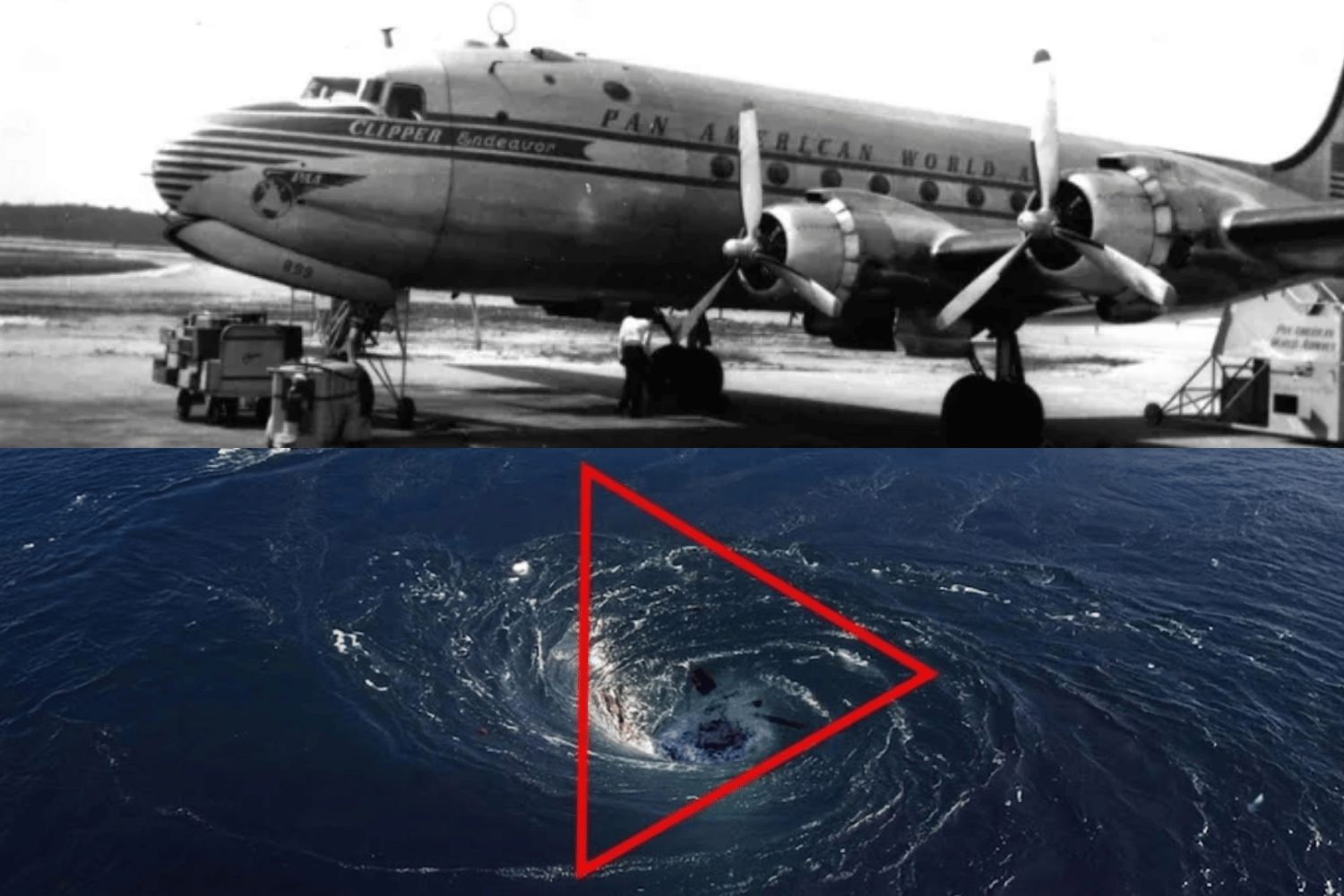
The plane sank into one of the world’s most difficult places to search.
For generations, the Bermuda Triangle has been sold as a place where airplanes and ships simply vanish—swallowed by alien forces, time warps, or mysterious magnetic fields.
But the discovery of Pan Am Flight 256, also known as Clipper Endeavor, is adding another powerful piece of evidence that reality is far less mysterious than the legend.
After lying undiscovered for more than seven decades, the aircraft was found about 2,000 feet beneath the Atlantic Ocean by a joint expedition involving the Air/Sea Heritage Foundation, Deep Sea Vision, and Discovery Channel’s Expedition Unknown. Using an autonomous underwater vehicle equipped with high-resolution sonar, researchers located the Douglas DC-4’s split fuselage, with the iconic “Pan American” name and “Clipper Endeavor” still visible on the wreckage.
The discovery doesn’t reveal a supernatural mystery. It confirms what investigators had believed all along.
On April 11, 1952, the aircraft departed San Juan, Puerto Rico, for New York. Just nine minutes after takeoff, both engines on its right wing failed in quick succession, forcing the crew to ditch the plane into the Atlantic. All 69 people on board survived the impact, but tragedy struck moments later. Without modern pre-flight safety demonstrations, many passengers were unable to locate life vests or emergency exits before the aircraft sank within minutes. Fifty-two people ultimately lost their lives.
Ironically, the disaster helped reshape aviation safety. The accident became one of the catalysts for mandatory pre-flight safety briefings, requiring airlines to show passengers where emergency exits and flotation devices are located before every flight.
For believers in the Bermuda Triangle, the case has long been folded into the region’s growing mythology. Yet the newly discovered wreck points to something much simpler.
The plane never vanished into another dimension. It sank into one of the world’s most difficult places to search.
In 1952, rescuers already knew roughly where the aircraft had gone down, but sonar technology at the time simply wasn’t capable of finding wreckage resting hundreds of meters below the ocean’s surface. Powerful currents, rugged underwater terrain, and the sheer depth of the Atlantic concealed the aircraft for decades—not paranormal forces.
That explanation aligns with what scientists have been saying for years.
The U.S. National Oceanic and Atmospheric Administration (NOAA) has consistently maintained that the Bermuda Triangle experiences no greater rate of disappearances than any other heavily traveled stretch of ocean. Most incidents can be explained by mechanical failures, human error, severe weather, strong currents, and the challenges of searching one of the deepest parts of the Atlantic.
The Bermuda Triangle legend itself is relatively modern. While stories often point back to Christopher Columbus or the disappearance of Flight 19 in 1945, the phrase “Bermuda Triangle” wasn’t coined until writer Vincent Gaddis published The Deadly Bermuda Triangle in 1964. A decade later, Charles Berlitz’s bestselling book The Bermuda Triangle turned the area into a global pop culture phenomenon, popularizing theories involving Atlantis, extraterrestrials, magnetic anomalies, and time portals.
Those stories continue to fascinate audiences because they make the unknown feel extraordinary.
But discoveries like Pan Am Flight 256 remind us that the ocean keeps its secrets for reasons that are often geological, technological, and scientific—not supernatural.
Sometimes the greatest mystery isn’t why something disappeared.
It’s simply how long it takes us to finally find it.
READ:

Philippine Airlines doubles down on fleet expansion with 9 new Airbus A350-1000 jets
Kenneth M. del Rosario
July 22, 2026
New airport training aims to make Bohol flights more reliable
John Lloyd Aleta
July 8, 2026

Philippine Airlines buys 15 Boeing 787 Dreamliners in major bet on international growth
Kenneth M. del Rosario
July 20, 2026
Tags: Air/Sea Heritage FoundationAtlantic OceanaviationBermuda TriangleCharles BerlitzChristopher ColumbusClipper EndeavorDeep Sea VisionDiscovery ChannelDouglas DC-4mythsNational Oceanic and Atmospheric AdministrationNew YorkPan Am Flight 256Pan American World AirwaysPuerto RicosafetySan JuanVincent Gaddis