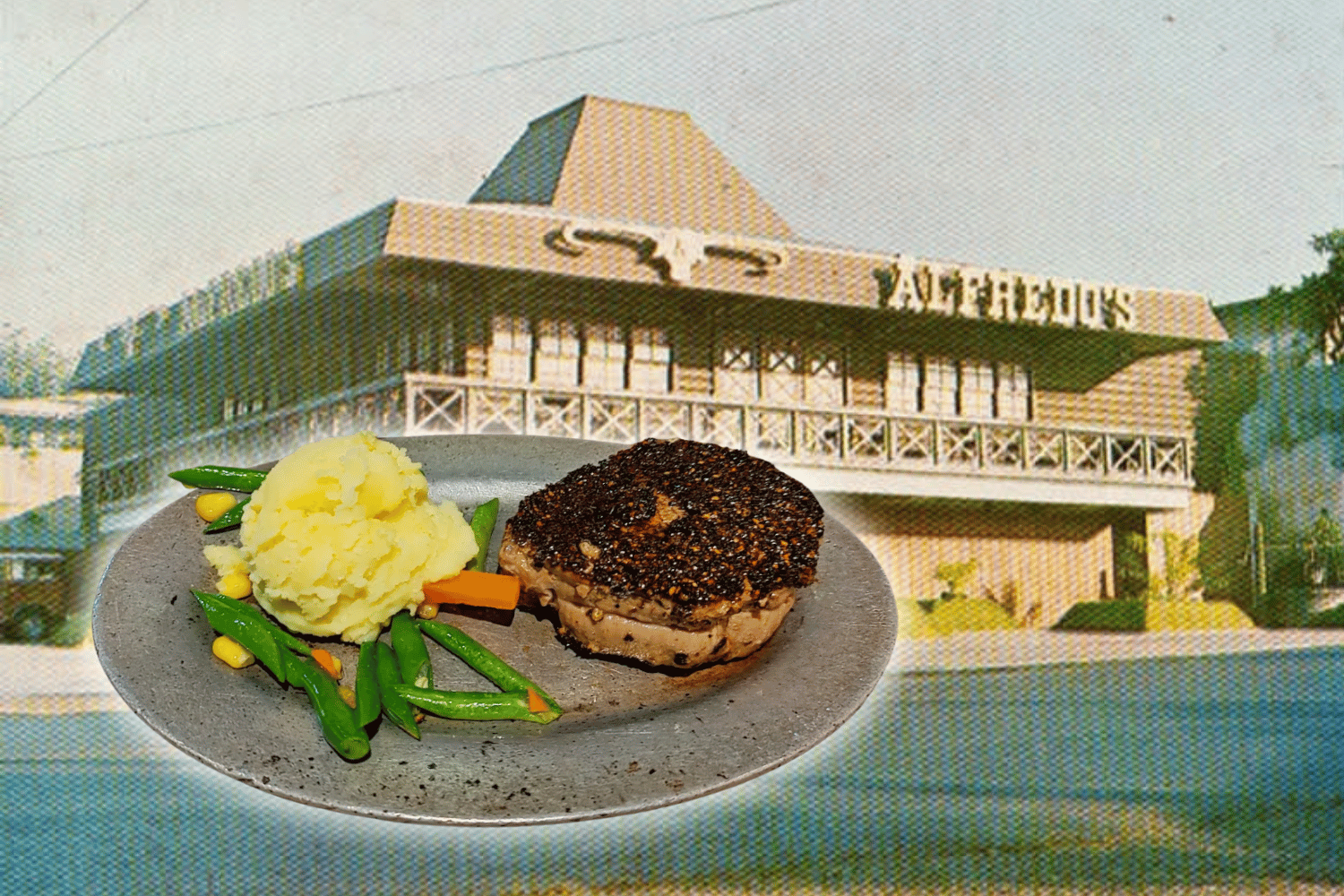
The rise and farewell of a 54-year Quezon City institution.
Businessmen discussing deals over steak dinners. Politicians entertaining important guests. Families celebrating graduations, birthdays, and anniversaries. Young couples dressing up for a special date.
There was a time when these scenes were part of everyday life at Alfredo’s Steak House, one of Quezon City’s most celebrated dining institutions.
Long before Tomas Morato Avenue became crowded with trendy cafés, Korean barbecue restaurants, and international dining chains, Alfredo’s had already established itself as a destination for people who wanted something more than an ordinary meal.
For 54 years, it represented a particular kind of dining experience: respectable, comfortable, and special enough to make an ordinary evening feel like an occasion.
When steak was something special
The story began in 1968 when husband and wife Alfredo and Mitos Araneta opened a modest restaurant called Alfredo’s Country-Style Steaks along Timog Avenue.
Alfredo, a University of Santo Tomas alumnus and farming enthusiast who loved grilling meat, lent his name and culinary passion to the establishment.
At a time when eating steak was not yet a routine experience for many middle-class Filipino families, Alfredo’s helped introduce a more accessible version of Western-style steakhouse dining.
Its growing popularity eventually prompted the Aranetas to build a larger restaurant at the corner of Tomas Morato Avenue and Scout Lazcano Street in 1973.
The distinctive two-story pine-log structure would become a Quezon City landmark.
Inside, diners encountered a rustic, American-inspired atmosphere, complete with dark wooden interiors, red-and-white checkered tablecloths, and windows overlooking the avenue.
Eating there carried a certain sense of occasion.
A restaurant for the city’s who’s who
As Alfredo’s reputation grew, so did its clientele.
Business executives, politicians, celebrities, and prominent families became part of its dining crowd. Among its notable patrons was the late President Benigno “Noynoy” Aquino III.
But Alfredo’s appeal extended beyond the rich and influential.
For middle-class families, dining there could be an occasional indulgence, something worth saving for and remembering afterward.
Its menu helped establish that reputation. Tenderloin a la pobre, filet mignon, and other steakhouse favorites became signatures, while the complimentary clear chicken soup and warm pandesal were familiar comforts for generations of customers.
The restaurant served imported beef, including cuts sourced from New Zealand and Argentina, at prices that made the steakhouse experience accessible to a wider clientele than the most exclusive fine-dining establishments.
In many ways, Alfredo’s became part of Quezon City’s social history. It was where relationships began, business deals were discussed, family milestones were celebrated, and generations returned to relive familiar memories.
Before Tomas Morato became a food destination
Today, Tomas Morato is synonymous with dining and nightlife. But that reputation did not develop overnight.
When Alfredo’s opened its landmark restaurant in 1973, the area had yet to become the dense commercial dining district familiar to younger generations.
Its presence helped establish the avenue as a place where people deliberately traveled to eat.
Unlike today’s restaurant scene, where establishments can become overnight sensations through social media, Alfredo’s built its reputation over decades through repeat customers, word of mouth, and family traditions.
Its longevity was remarkable in an industry where restaurants frequently open and close as consumer tastes change.
The end of a 54-year institution
The COVID-19 pandemic dealt Alfredo’s a serious blow.
Dine-in operations were suspended in 2020, forcing the restaurant to experiment with takeout, delivery, and eventually outdoor dining.
But the pandemic was not the only factor behind its closure.
According to Lisa Araneta, the founders’ daughter who managed the restaurant in its later years, the property had already been sold. A temporary lease extension allowed the family to continue operating until June 2022.
On June 30, 2022, Alfredo’s served its final meals and permanently closed after 54 years.
The date carried an unusual historical coincidence. The restaurant had opened during the presidency of Ferdinand Marcos Sr. and closed on the day Ferdinand Marcos Jr. assumed office.
The family also reported providing compensation packages to employees affected by the closure.
The familiar log-cabin structure was subsequently cleared for redevelopment, ending the physical presence of one of Quezon City’s best-known restaurants.
More than just a steakhouse
What made Alfredo’s important was not simply the quality of its steaks or the number of famous personalities who ate there.
It was the place the restaurant occupied in the lives of its customers.
Before dining became an everyday lifestyle activity documented through Instagram posts and online reviews, going to a restaurant like Alfredo’s could be an event in itself.
People dressed for the occasion, gathered around the table, ordered something special, and stayed long enough to enjoy the company.
For generations of Quezon City diners, Alfredo’s was not merely somewhere to eat. It was somewhere to celebrate having arrived at an important moment in life.
And although the restaurant is gone, its legacy remains part of the story of how Tomas Morato became one of Metro Manila’s most important dining districts.
READ:
FLASHBACK: Tomas Morato was once lined with sampaloc trees
Top Dagohoy
September 27, 2026
FLASHBACK: People Are People once dressed Manila’s cool kids
Top Dagohoy
October 1, 2026
Where to eat the best pares?
Top Dagohoy
September 9, 2026