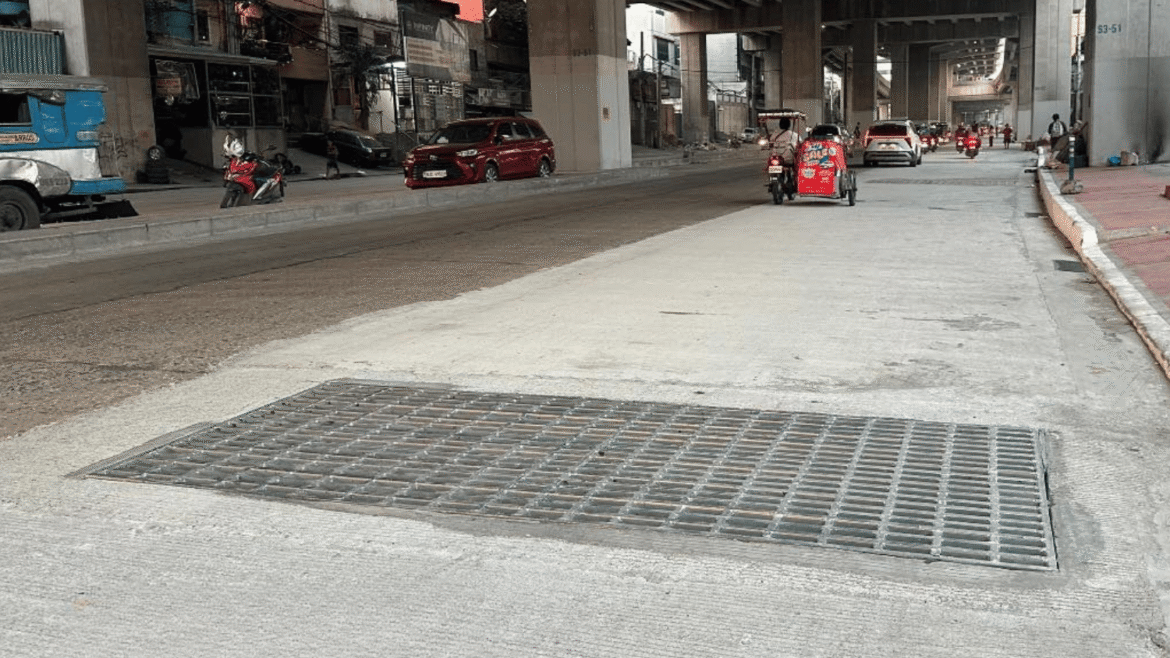
“Was anyone actually thinking about the people who would have to use them?” Nava asked.
His concern goes beyond the tactile blocks themselves.
“Is the sidewalk actually navigable? Is the crossing safe? Are vehicles slowed down where pedestrians need to cross? Is there proper traffic calming?” he wrote.
For Nava, accessibility cannot be reduced to simply installing a strip of tactile paving and declaring the sidewalk compliant.
“Accessibility isn’t about installing individual features and checking a box. The entire journey has to work—and it has to be safe,” he said.
He also suggested that the entire stretch be audited, not just the tactile paving but the whole pedestrian experience from end to end.
Tactile paving has a purpose
Under Batas Pambansa Blg. 344, or the Accessibility Law, and its 2024 Revised Implementing Rules and Regulations, tactile ground surface indicators are meant to help persons with visual impairment navigate public spaces using their feet or a white cane.
Different patterns serve different purposes.
Directional blocks, with raised lines, guide pedestrians along a safe route. Warning blocks, usually made of raised dots, alert users to hazards such as stairs, ramps, curb edges, and areas where pedestrians encounter vehicular traffic. Positional blocks indicate decision points or changes in direction.
The revised rules also require warning tactile strips to be placed before hazards and for pedestrian routes to maintain enough clear width for persons with disabilities, including wheelchair users.
The paving itself must also be slip-resistant, durable, and visually contrasting enough to assist people with low vision.
But what if the path leads to a hazard?
That is the larger issue raised by Nava’s photos.
Tactile paving is supposed to guide a visually impaired pedestrian toward a continuous and safe path. If that route is interrupted by holes, poles, damaged sidewalks, or unsafe crossings, then the accessibility feature risks becoming decorative rather than functional.
The photos alone do not prove a legal violation, and a proper on-site technical inspection would still be needed to determine whether the installations comply with BP 344 and its revised rules.
But they do highlight a basic principle of universal design: accessibility should be judged from the perspective of the person actually using it.
A tactile strip means little if the pedestrian following it must suddenly avoid an open hole, squeeze past an obstruction, or step into fast-moving traffic.
The bigger question, then, is simple: Was accessibility truly designed into the journey—or was it merely added onto the sidewalk?
READ: