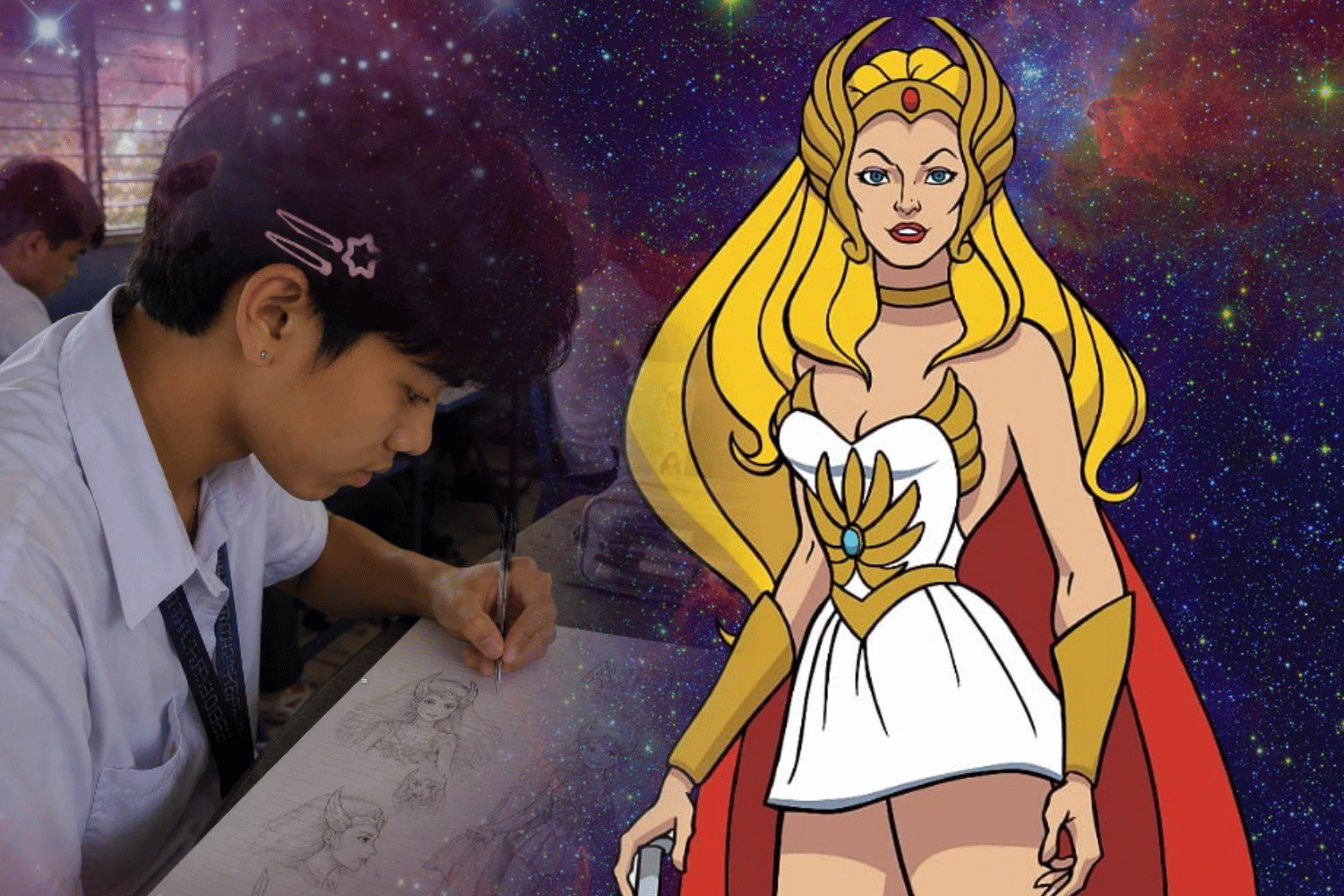
Princess Adora declared herself as She-Ra, never asking for permission.
I must have drawn her hundreds of times.
She was there at the back of my notebooks—long blonde hair, crown, cape and, of course, that sword.
She-Ra.
I was in elementary school in the late 1980s and early 1990s, when “She-Ra: Princess of Power” was part of my childhood television universe. I was a queer kid, although I didn’t have those words for myself yet. What I knew was that I was different. And I was obsessed with She-Ra.
My teachers knew this, too.
Whenever they checked my notebooks, there she was. She-Ra on the back pages. She-Ra squeezed between lessons. I was reprimanded many times for those drawings.
I don’t remember most of the lessons in those notebooks anymore. I remember her.
Back then, I thought I loved She-Ra simply because she was beautiful and powerful. She was feminine without being fragile, glamorous while being a fighter.
But there was something else I couldn’t articulate.
She-Ra was Princess Adora. Most days, Adora could walk around appearing almost ordinary. But hidden inside her was another identity—stronger, freer, more spectacular.
All she had to do was raise her sword.
“For the honor of Grayskull!”
And she transformed.
As a child, I saw magic. As an adult, I see metaphor.
There is something profoundly queer about carrying an identity inside yourself that the rest of the world cannot see. Queer children learn early that there are things about ourselves we reveal and things we conceal.
Perhaps that’s why transformation sequences fascinated me.
Adora didn’t ask permission to become She-Ra. She declared herself. There was music, light, color and absolutely nothing apologetic about it.
For queer kids growing up in the ’80s and ’90s, when LGBTQ+ characters were largely absent from children’s television, we learned to find ourselves in subtext.
And “She-Ra” had plenty of it.
Etheria was gloriously excessive: princesses, sorceresses, elaborate costumes, impossible hairstyles, rainbow colors and flamboyant villains. Even Bow challenged the hypermasculine heroes of the era, fighting alongside women in his famously revealing costume.
It was camp before I knew what camp meant.
The show also celebrated something queer people would later call chosen family. Adora leaves the Evil Horde and finds the Great Rebellion—a community of wildly different people who protect one another.
Today, I have words for all of this: the closet, gender expression, camp, chosen family, queer coding.
The boy drawing She-Ra in his notebook didn’t.
He simply knew something about her felt familiar.
Maybe those drawings weren’t merely doodles. Maybe they were rehearsals.
The teachers who opened my notebooks probably saw pages ruined by drawings.
Today, I see a queer child who did not yet know how to draw himself, so he kept drawing a woman who could transform into her most powerful self.
A child who didn’t yet have the vocabulary for identity, but already understood the fantasy of revelation.
A child waiting for his own sword to raise.
“For the honor of Grayskull!”
Back then, it was a cartoon catchphrase.
Today, it sounds a little more like coming out.
READ: