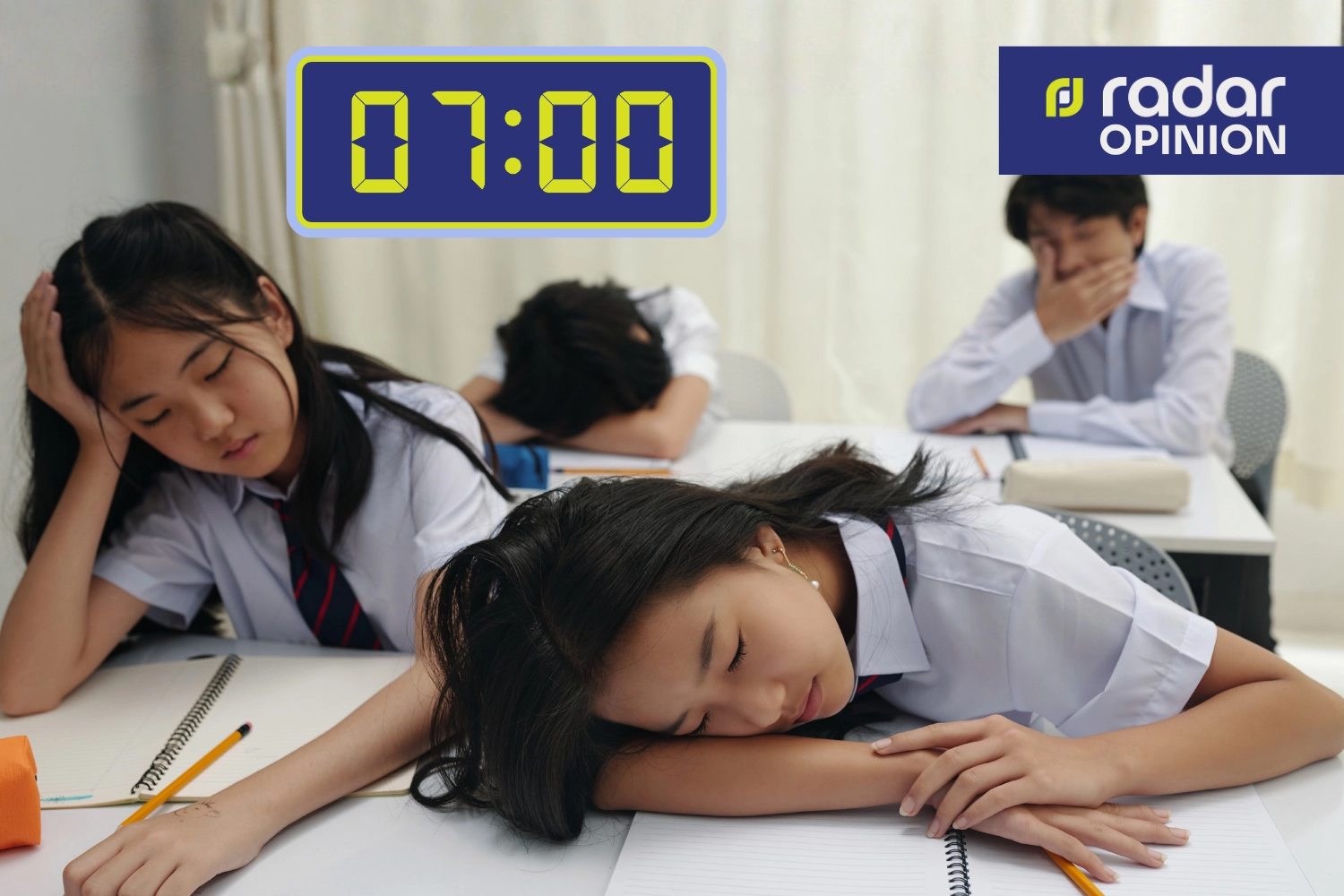
I have always wondered why we expect Filipino students to perform at their best when we practically force them to begin their school day exhausted.
Consider a student living in Antipolo who attends school in Quezon City. Classes begin at 7 AM, but the commute takes an hour or longer.
That means waking up at 4:30 or 5 AM, preparing breakfast, and rushing to catch a jeepney, bus, or UV Express.
By the time the student reaches school, the morning has already been exhausting. And the first lesson hasn’t even started.
We call this discipline. But medical research suggests we should reconsider.
Science supports later classes
The American Academy of Pediatrics (AAP), in its 2014 policy statement published in the journal Pediatrics, recommended that middle and high schools begin no earlier than 8:30 AM.
The reason is biological. During puberty, adolescents experience a natural shift in their circadian rhythm, making it harder to fall asleep early.
The American Academy of Sleep Medicine recommends eight to ten hours of sleep for teenagers aged 13 to 18.
A student waking at 4:30 AM must fall asleep by 8:30 PM to obtain even the minimum eight hours.
How realistic is that after homework, school projects, household responsibilities, and commuting?
Sleep deprivation has consequences
According to the US Centers for Disease Control and Prevention (CDC), insufficient sleep among children and adolescents is associated with attention problems, poor mental health, obesity, and increased risk of injuries.
A 2022 meta-analysis published in Pediatrics, examining 28 studies involving approximately 1.77 million participants, found that later school start times were associated with longer sleep, better developmental outcomes, and less negative mood.
However, a separate 2022 systematic review in Sleep Medicine Reviews found mixed evidence regarding improvements in grades and test scores.
The strongest argument for later classes, therefore, is protecting students’ health and ensuring adequate sleep, not guaranteeing higher grades.
This is also a class issue
I cannot ignore how early classes disproportionately burden students living far from school.
A child living five minutes away has a different morning from someone commuting from Bulacan, Rizal, or Cavite.
Parents wake before sunrise to prepare baon. Students travel while it is still dark. Some may sacrifice breakfast just to arrive on time.
These are familiar Philippine realities, although the international studies cited here do not establish how widespread these experiences are locally.
Why not start at 8:30 AM?
I understand that Philippine schools face classroom shortages, multiple shifts, and transportation challenges.
But these should encourage serious discussion about scheduling, not automatically justify 7 a.m. classes.
The AAP itself recognizes commuting times and local conditions as important considerations.
I believe schools should examine later starting times, particularly for junior and senior high school students.
Education is already demanding. We should not make exhaustion a prerequisite for learning.
Let students sleep a little longer.