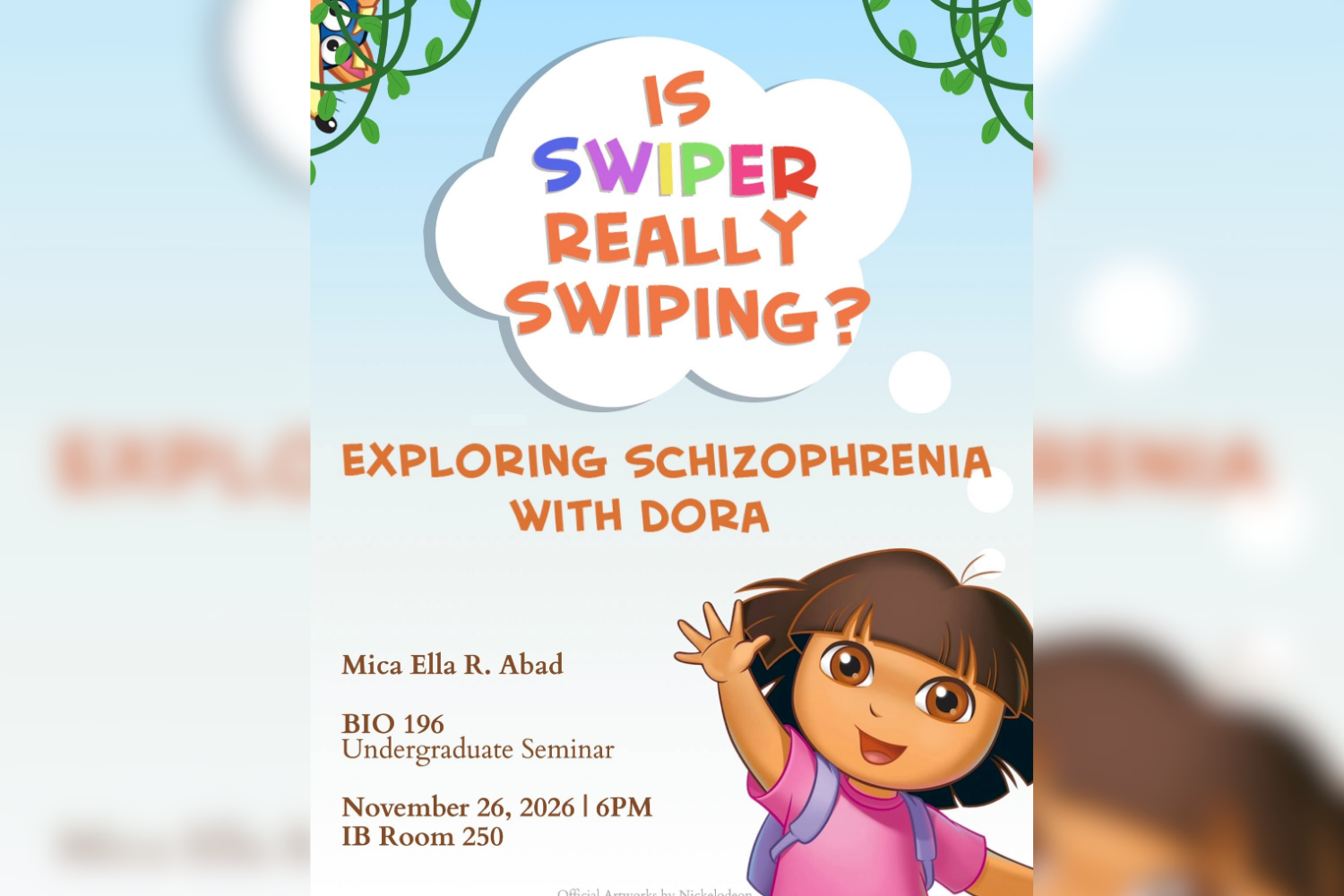
The University of the Philippines Diliman Institute of Biology has caught netizens’ attention after announcing an undergraduate seminar titled “Is Swiper Really Swiping? Exploring Schizophrenia with Dora,” which uses characters and scenarios from the beloved children’s animated series to discuss the neurobiology and clinical characteristics of schizophrenia.
The unconventional approach has drawn amused but enthusiastic reactions online, with some netizens expressing interest in attending and others praising the intersection of popular entertainment and scientific education.
“I love some intersection of natural sciences and fiction! It’s entertainment with actual educational value. This is just like sci-fi, where you get to explore imaginative possibilities while learning about real scientific concepts,” one commenter wrote.
Another netizen, apparently familiar with the institute’s undergraduate seminars, said such unconventional approaches were nothing new to the department.
“Wanna know the details also, pero ‘di na bago to sa undergrad seminars ng IB,” the commenter said.
Organized under BIO 196, the seminar will be delivered by Mica Ella R. Abad on November 26, 2026, at 6 p.m. in Room 250 of the Institute of Biology.
Cartoon meets science
While its title might sound like an elaborate internet joke, the subject itself is anything but.
Schizophrenia is a complex psychiatric disorder that can affect how a person thinks, perceives reality, and interprets experiences. It is also frequently surrounded by misconceptions, with popular portrayals sometimes reinforcing rather than correcting public misunderstandings.
Using familiar fictional characters as teaching material offers a different way to approach the complicated subject. Rather than overwhelming audiences with unfamiliar medical terminology, the seminar draws on recognizable childhood entertainment to encourage curiosity about neuroscience and mental health.
Of course, this does not mean Dora or Swiper should be treated as clinical examples of schizophrenia. The characters and their situations serve as a framework for scientific discussion, not as subjects for diagnosis.
More than a joke
Still, the response to the announcement points to something worth considering: Sometimes, making difficult subjects easier to talk about begins with making them less intimidating.
And if it takes a children’s cartoon and a suspiciously busy fox to get people interested in learning about schizophrenia, perhaps we should let Dora lead the way.
After all, we’ve spent years helping her find her way through the forest. We might as well learn a little neuroscience along the way.






Elijah Canlas calls out Senate drama, urges vigilance vs ‘stalling’ senators