The issue reflects ongoing conflict between public health rules and extra costs placed on pet owners.
A pet owner in San Jose del Monte, Bulacan, has taken to social media to question a city ordinance requiring residents to register their dogs and cats for ₱100 each, arguing that taxpayers are being made to shoulder yet another expense for a government-mandated program.
In a Threads post, user @jadpacheco_ expressed frustration over the registration requirement, questioning why residents must pay additional fees despite already paying taxes.
“Ano ito, SJDM LGU?! Kailangan pa naming magparehistro ng mga alaga naming pusa at aso sa halagang ₱100?! Lahat na lang talaga, sa amin ninyo ipinapasa ang gastos,” the netizen wrote.
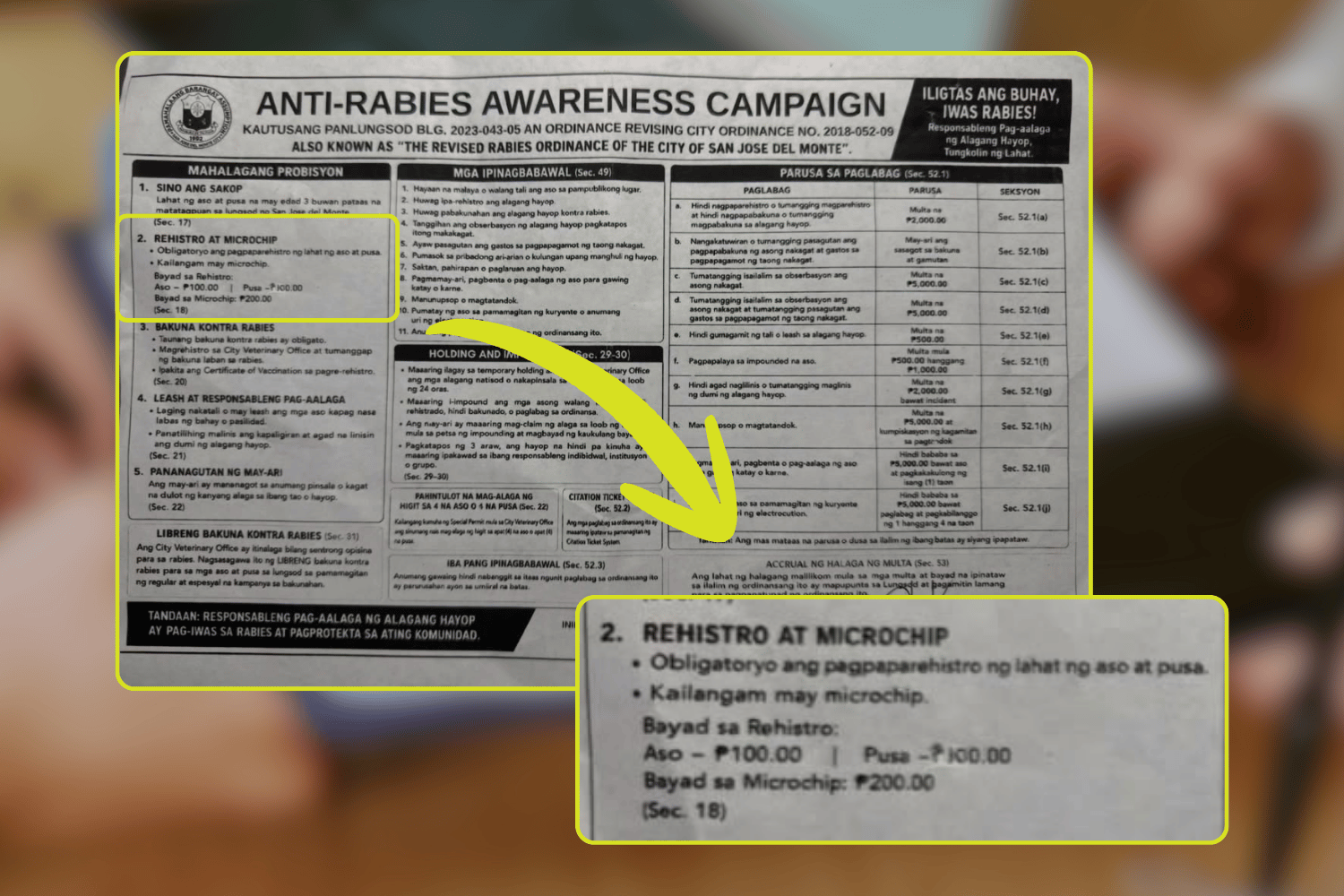
The complaint was accompanied by a photograph of an anti-rabies awareness campaign flyer outlining the city’s pet ownership regulations and corresponding penalties.
What the ordinance requires
Under City Ordinance No. 2023-043-05, which revises the city’s earlier rabies ordinance, owners of dogs and cats aged three months and older must register their pets.
The flyer lists a registration fee of ₱100 for dogs and ₱100 for cats, plus a separate ₱200 microchipping fee.
This means registering and microchipping one pet could cost an owner ₱300, while households with several animals could face considerably higher expenses.
The ordinance also requires rabies vaccination, responsible pet ownership, and proper control of animals in public places.
According to the flyer, the City Veterinary Office provides free anti-rabies vaccination through designated centers and scheduled community programs.
Fines reach ₱5,000
The ordinance carries penalties for noncompliance.
Pet owners who fail or refuse to register their animals face a ₱2,000 fine, while those who refuse to have their pets vaccinated against rabies may be required to shoulder vaccination and treatment expenses.
Other violations, including refusing to place an animal under observation following a bite incident, carry fines of up to ₱5,000.
Allowing pets to roam without a leash can also result in a ₱500 fine.
Is the registration fee legal?
Under Republic Act No. 9482, or the Anti-Rabies Act of 2007, local government units are responsible for implementing animal registration, vaccination, and rabies prevention programs.
The law also recognizes the authority of local governments to collect registration fees under applicable regulations.
Meanwhile, Republic Act No. 7160, or the Local Government Code, authorizes cities to impose reasonable fees and charges through duly enacted ordinances.
This means the ₱100 registration requirement is not automatically illegal simply because residents already pay taxes.
However, questions about the reasonableness of the fees, their implementation, and how collections are used remain legitimate matters of public accountability.
Pet owner questions additional expense
For the complainant, the issue goes beyond the amount being collected.
“Gagawa kayo ng batas, tapos sa amin pa kukunin ang pondong kailangan para maipatupad ito?” the netizen wrote, also expressing frustration over corruption issues in government.
The user subsequently asked whom residents could approach to raise a formal complaint.
The controversy highlights a familiar tension between public health regulations and the financial burden of compliance, particularly for households caring for multiple rescued or adopted animals.
While rabies prevention remains a critical public health responsibility, the complaint raises a broader question: How much should responsible pet ownership cost, and how much of that expense should local governments shoulder?
The city government’s response to the social media complaint was not included in the material reviewed.
READ:
Pet-friendly doesn’t mean anything goes
Top Dagohoy
September 27, 2026

Zus Coffee roasted for allowing dog on table
Kiara Gorrospe
October 23, 2026
Six things to settle before you bring a pet home
Mianne Cudal
October 10, 2026