The rich history, faith, and artistry behind Pampanga’s heirloom Pan de San Nicolas cookies.
There is something almost sacred about holding a San Nicolas cookie.
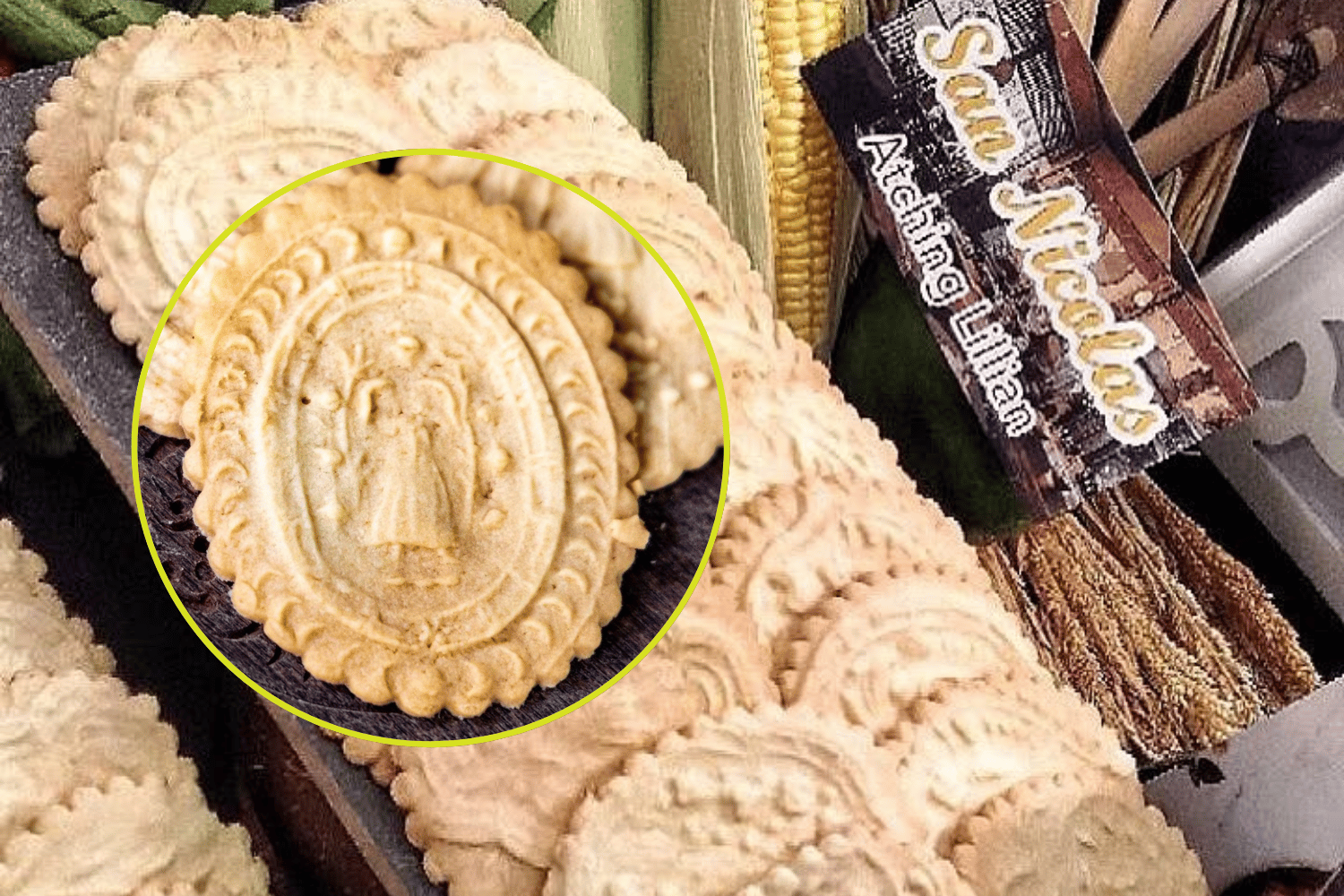
Before you even take a bite, your fingers trace the delicate image embossed on its surface—flowers, vines, crosses, and often the likeness of Saint Nicholas of Tolentino. It feels less like a biscuit and more like a tiny work of art, carefully pressed into dough using heirloom wooden molds that have survived generations.
In Pampanga, Pan de San Nicolas—or simply “Sanikulas”—is more than a delicacy. It is edible heritage.
For over 400 years, these buttery shortbread cookies have carried stories of faith, ingenuity, colonial history, and family tradition, making them among the oldest surviving cookies in the Philippines.
Born from a problem
Ironically, the cookie owes its existence to church construction.
When Spanish Augustinian friars built massive stone churches across the country in the 1600s, builders mixed egg whites with lime and crushed eggshells to create stronger mortar. That process left enormous quantities of unused egg yolks.
Rather than letting them go to waste, Spanish nuns taught local women to transform the yolks into pastries. Kapampangans adapted the recipes using native ingredients like coconut milk and uraru (arrowroot flour), eventually creating the crisp, buttery cookie now known as Pan de San Nicolas.
Sometimes, history isn’t only written in stone. Sometimes, it’s baked.
A cookie with a blessing
The cookies are named after Saint Nicholas of Tolentino, the Augustinian friar revered as the patron saint of bakers and the sick.
Catholic tradition tells of the saint recovering from illness after eating blessed bread. Inspired by this story, the Church eventually allowed small biscuits to be blessed in his honor, a devotion that Spanish missionaries brought to the Philippines.
For generations, many Kapampangan families kept San Nicolas cookies inside glass jars instead of cookie tins.
When someone became ill, a cookie would be offered together with a prayer asking for the saint’s intercession. Farmers even crushed blessed cookies into their rice fields, believing they would bring protection and a good harvest.
Did they really heal?
Perhaps the most fascinating part of the story is that the legend may not have been entirely rooted in faith alone.
Food historians have observed that cookies stored for long periods inside traditional jars sometimes developed natural mold. Some researchers believe these molds may have contained naturally occurring penicillin-producing fungi, potentially helping fight certain bacterial infections long before antibiotics were formally discovered.
While modern medicine should never replace proven medical treatment with folk remedies, the coincidence offers an intriguing scientific footnote to centuries of oral tradition.
Every cookie is a piece of history
The soul of the cookie lies in its wooden molds.
Each one is painstakingly hand-carved with intricate religious and botanical designs, producing embossed cookies that resemble embroidered lace. Many Kapampangan families still treasure molds inherited from grandparents and great-grandparents, some dating back to the 19th century.
No two heirloom molds tell exactly the same story.
Keeping the tradition alive
Today, only a handful of artisans continue making authentic San Nicolas cookies the traditional way.
Among the most respected is Kapampangan culinary historian Atching Lillian Borromeo, whose lifelong work has helped preserve many of Pampanga’s endangered culinary traditions. Through her efforts, a cookie once baked only for a saint’s feast day continues to find new admirers.
In an age of factory-made snacks and viral desserts, Pan de San Nicolas reminds us that food can carry something far greater than flavor.
It can preserve memory.
It can tell history.
And sometimes, it can keep a culture alive—one beautifully carved cookie at a time.
READ:
False claim that Filipinos ‘stole’ China’s lumpia gets history wrong
Nikko Miguel Garcia
May 30, 2026
Curacha is the seafood that tells the story of Zamboanga
radar Lifestyle
June 30, 2026
The history of Filipino frozen delights
Jose Victor Z. Torres
May 11, 2026