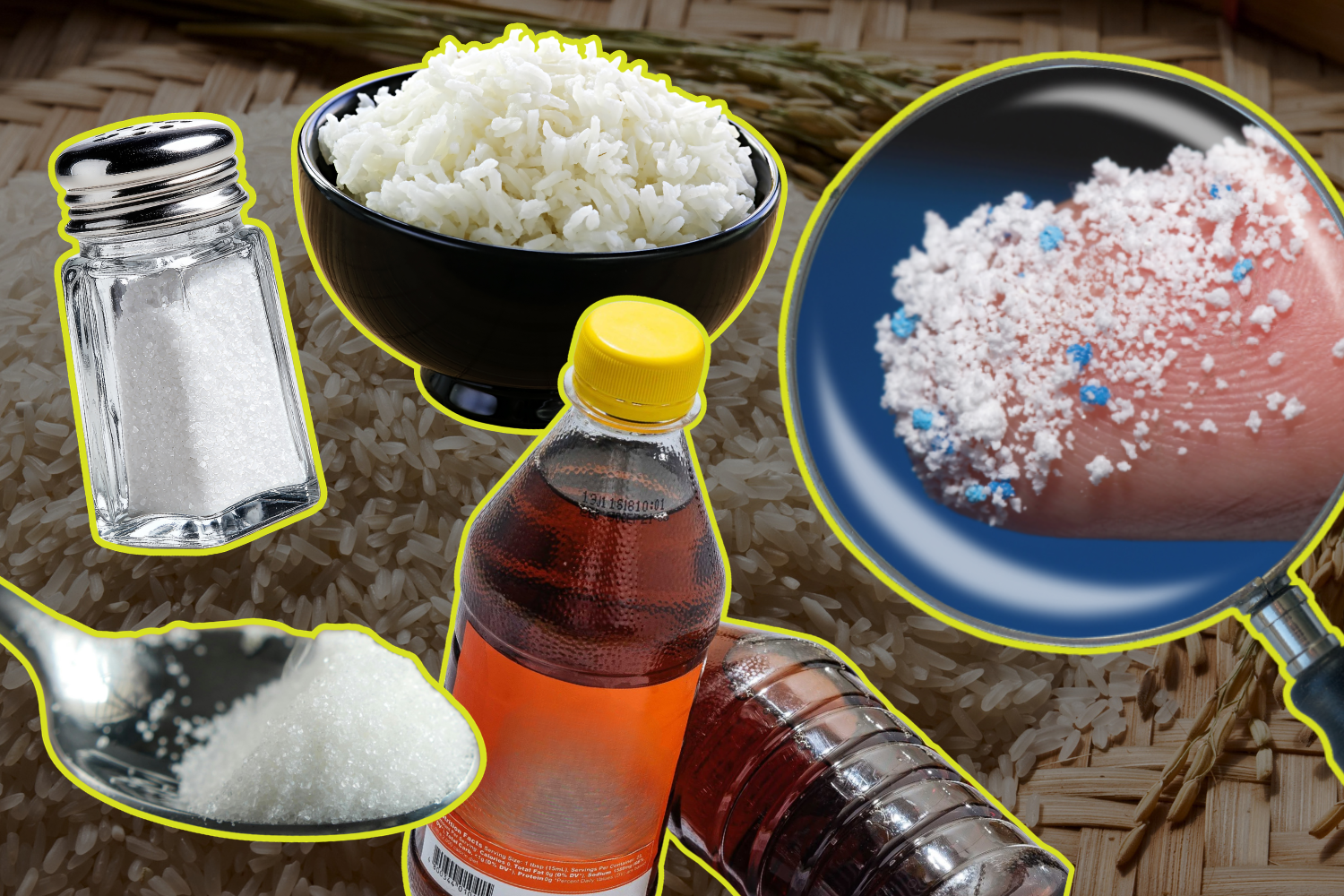
The study estimated that a person could ingest about 1,788 particles yearly from salt, 298 from sugar, and 469 from rice.
You sprinkle salt on your egg, add sugar to your coffee, pour patis into your meal, and eat everything with rice. It looks like an ordinary Filipino breakfast—but tiny pieces of plastic may already be on your plate.
A 2024 study titled “Microplastics Contamination in Selected Staple Consumer Food Products,” published in the Journal of Food Science and Technology, detected microplastics in sea salt, white and brown sugar, fish sauce, and rice sold in Philippine wet markets and supermarkets.
Researchers used Raman microspectroscopy to examine the samples and identified 850 plastic particles ranging from 0.05 to 4.4 millimeters.
Sea salt recorded the highest average concentration at 471 microplastics per kilogram. White sugar contained 20 particles per kilogram, brown sugar had 67, fish sauce had three per liter, and cooked rice had five per kilogram.
Most of the particles were fibers. The plastics detected included polyvinyl chloride (PVC), polypropylene, polyethylene, polyethylene terephthalate (PET), polystyrene, polyacrylonitrile, and polytetrafluoroethylene.
In sea salt, 71 percent of the particles were PVC. Researchers said these may have come from plastic pipes, scrapers, sacks, drying sheets, sprayers, and other materials used during salt production.
PET and polypropylene fibers found in sugar were likely shed from woven sacks, polyester bags, plastic strings, and equipment used during manufacturing and storage.
Fish sauce contained particles potentially released by plastic bottles, caps, drums, basins, and buckets used during fermentation and packaging.
Perhaps most unsettling were the findings on rice. PET fibers remained in cooked rice even after the grains were washed three times. Researchers estimated that one cup of rice could contain around 0.5 to 1 microplastic particles.
Based on average Filipino consumption, the study estimated that a person could ingest about 1,788 particles yearly from salt, 298 from sugar, and 469 from rice.
The figures do not mean that every product has the same contamination level, and scientists are still studying the long-term health effects of ingesting microplastics.
But the findings show that contamination may happen throughout the food supply chain—from processing and drying to storage, transport, packaging, and preparation.
Plastic may not appear on the ingredients list. Increasingly, however, scientists are finding it on the plate.
READ: