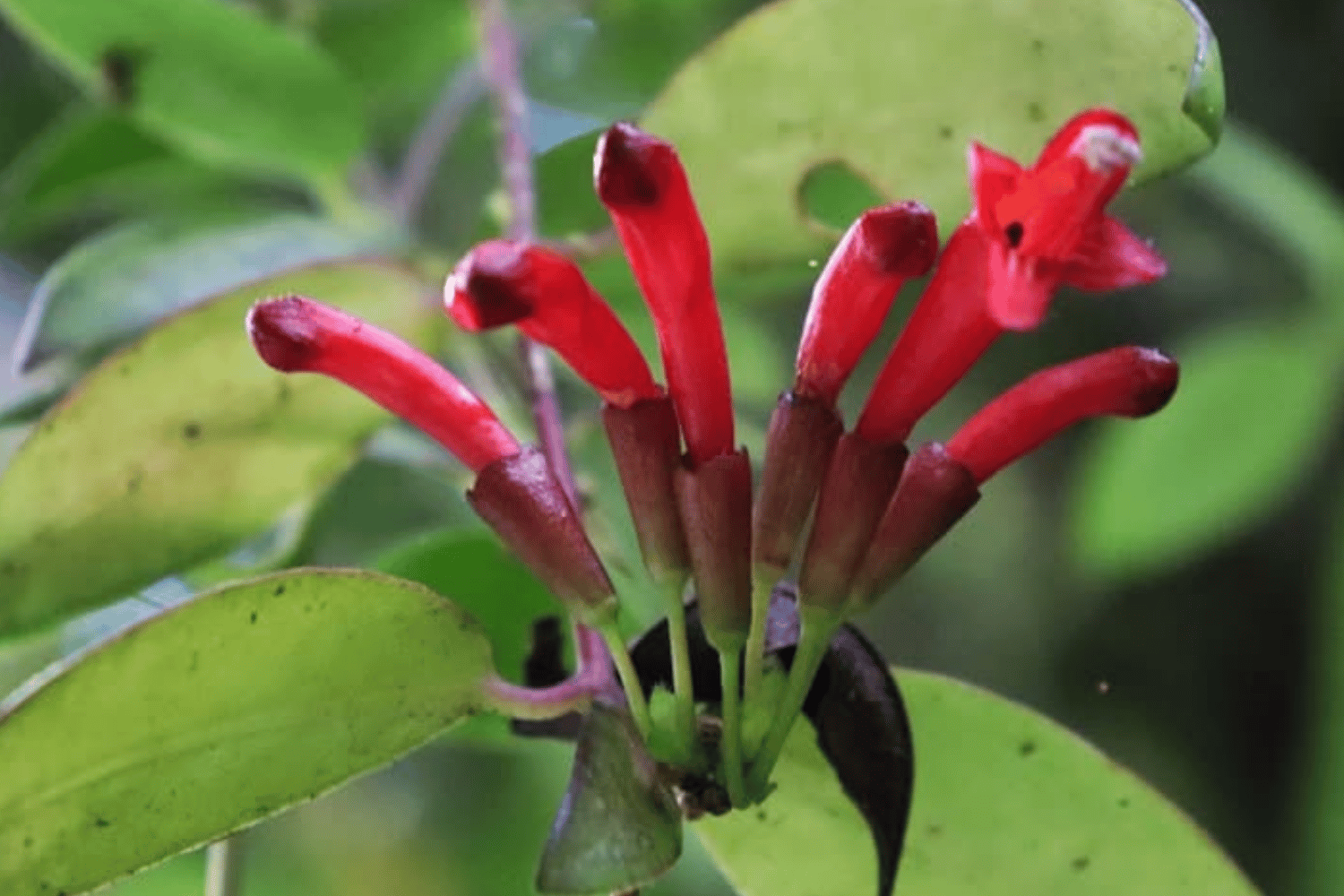
The Panay Lipstick Vine is one of the Philippines’ remarkable botanical survivors.
Imagine a plant disappearing from scientific records for an entire century—only to suddenly turn up again in a Philippine forest.
That is the remarkable story of the Panay Lipstick Vine, or “Aeschynanthus panayensis,” a flowering plant found naturally only on Panay Island.
The species belongs to the Gesneriaceae family and takes its popular name from the striking flowers associated with lipstick vines: elongated blooms that resemble lipstick emerging from a tube.
But what makes the Panay Lipstick Vine extraordinary is not simply its appearance. It is its rarity—and its dramatic return to scientific attention.
Lost for a century
Philippine botanists Pieter Pelser and collaborators document “Aeschynanthus panayensis” as endemic to Panay. According to Co’s Digital Flora of the Philippines, its original specimens were collected on the island in June 1919, with records indicating that it grows in forests along streams at around 600 meters elevation.
Then, for roughly a century, there were no documented sightings.
The Philippine Biodiversity Conservation Foundation reported that the species was finally recorded again during a biological expedition in the Mt. Agudo Mountain Range in Capiz.
The foundation described the discovery as the first record of the Panay Lipstick Vine in more than 100 years. At the time of the survey, the population in Pilar, Capiz represented its only known current distribution record.
A plant found nowhere else
Kew Science’s Plants of the World Online recognizes “Aeschynanthus panayensis” as an accepted species whose native range is restricted to Panay in the Philippines. It grows primarily in the wet tropical biome.
That tiny geographical range makes the plant especially important. Unlike ornamental lipstick plants cultivated in homes around the world, this species is part of Panay’s unique natural heritage.
Its survival is therefore tied directly to the survival of the island’s remaining forests.
And that makes its rediscovery more than a botanical curiosity.
A plant that managed to remain unseen by science for a century was still there—quietly surviving in the forests of Panay.
The question now is whether those forests will remain standing long enough for it to survive another hundred years.
READ: