Then my “biological mother” showed up.
If you are the bunso in a Filipino family, chances are you have been told at least once that you are ampon.
It is one of those jokes that somehow survives generations. Older siblings insist that you were adopted. A tita volunteers an elaborate backstory. Even your parents laugh instead of correcting them. Everyone is in on the joke—except the one person the joke is about.
In my case, I was not only told that I was adopted. I was told exactly who my biological mother was.
Her name was Inday na Libat.
In Waray, “libat” means cross-eyed. That was how everyone knew her in the barrio in Samar where my family once lived. She was a family friend who would occasionally walk for hours to town, carrying vegetables, root crops, and whatever else she had harvested to share with my parents.
And according to my brothers and sisters, she was my real mother.
I am the youngest of eight children—four boys and four girls. By the time I was old enough to remember things, most of my siblings were already much older than me. Only one brother was close to my age, just three years older. To everyone else, I was the baby of the family and the easiest target for every prank they could invent.
Whenever I misbehaved, refused to do chores, or complained about scrubbing our wooden floor with a bunot made from coconut husk, my siblings had the perfect threat.
If I did not obey, they would return me to Inday na Libat.
I believed every single word.
Looking back, it was ridiculous because I looked exactly like my family. My face was unmistakably a combination of my mother’s and father’s features. I was simply another version of my siblings, especially my three brothers. No one looking at us together would seriously question whether we had the same parents.
But a three- or four-year-old does not understand genetics or inherited facial features. A child only knows what the people he loves keep telling him.
So I cried.
Every single time.
My parents would laugh. My siblings would laugh even harder because my crying meant the prank was working. Nobody seemed to realize that somewhere inside my little head, I was preparing myself for the day someone would arrive and take me away from them.
Then one day, that moment came. Or at least, I thought it did.
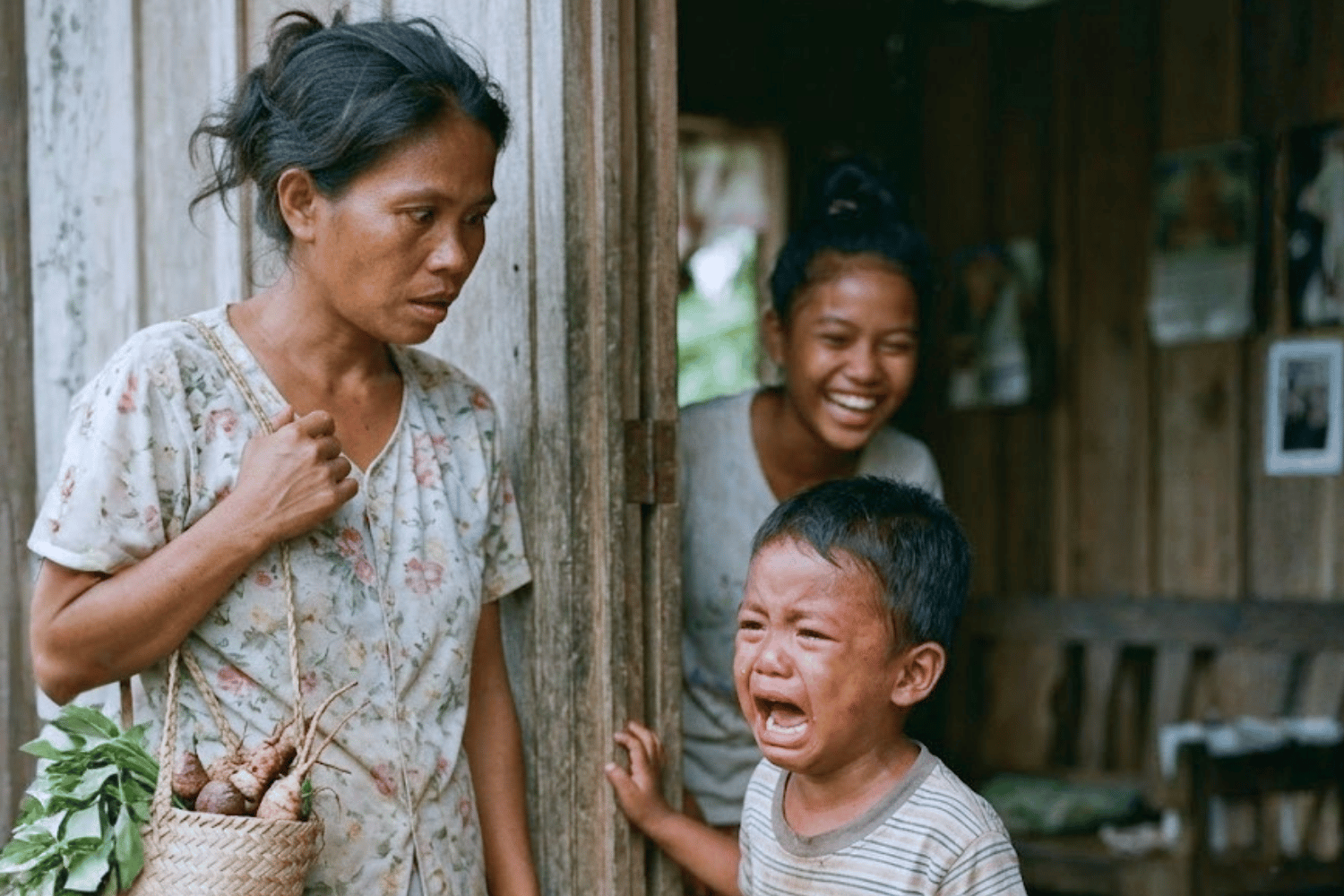
I still remember it with startling clarity. Someone knocked on our door. My sister opened it. Then she screamed my name and said:
“Nandito na si Inday na Libat! Kukunin ka na ng Nanay mo!”
I walked toward the doorway.
Standing there was the woman I had heard about for most of my young life.
She looked like a typical mother from the barrio. She must have been in her mid-30s or early 40s, although I cannot be certain. She had walked from the barrio to the center of town—a journey that could take two hours or even longer—and was carrying crops she had brought for my mother.
She was Inday na Libat.
The moment I saw her, I broke down.
It was not the ordinary crying children do when they are upset or do not get what they want.
In Waray, we have a word called “ula.” It describes the terrifying kind of crying in which a child sobs so hard that he can barely breathe and his face begins to turn purple.
That was what happened to me.
I cried until I could no longer catch my breath. I genuinely believed that the stories were true and that the woman standing at our door had finally come to take me away.
In my four-year-old mind, I was about to leave the only family I had ever known.
The adults were shocked.
For the first time, they realized that I had never understood any of it as a joke.
I had believed them all along.
I do not remember exactly what everyone said afterward, but I remember what changed. From that day on, whenever my siblings began teasing me again, my mother would make an effort to reassure me.
She would point to my face and compare my features with those of my brothers and sisters. She would tell me that I looked like my father, like her, and like everyone else in the family.
She would remind me that I was her bunso.
Her child.
And somehow, hearing those words from Nanay finally became louder than years of teasing.
Today, the story has become one of those family memories that we can laugh about. I can now appreciate how elaborate and persistent the joke was, and how completely I accepted the explanation everyone had given me.
But another thought has stayed with me.
I often wonder what Inday na Libat thought that day.
I remember the shock on her face as I cried at the sight of her. Did anyone explain why I reacted that way? Was she offended that a small child had become hysterical simply because she appeared at the door? Did she return to the barrio wondering why her friend’s youngest son seemed terrified of her?
I will probably never know.
Teasing the bunso about being adopted is common in many Filipino families. The youngest child is often the easiest target because he is too small to defend himself or recognize that everyone is only playing. Older siblings may also see the bunso as the most pampered child, so the joke becomes their way of knocking him down a peg and restoring what they consider the natural family hierarchy.
Sometimes, they point to a slightly different complexion, nose, height, or personality as supposed proof that the youngest child does not belong. Parents and relatives may join in because they also grew up hearing the same joke. It is passed from one generation to the next and treated as harmless family entertainment.
Most of the time, the teasing comes from affection. In Filipino households, jokes can be a form of lambing, a strange but familiar way of showing closeness and making someone feel part of the family’s private language.
But children do not always recognize affection when it arrives disguised as fear.
To my siblings, Inday na Libat was only the punchline of a running joke. To me, she was proof that I could lose my family at any moment.
Most bunso eventually discover the truth.
Some of us simply believe the joke longer—and more deeply—than anyone expects.
And if I could speak to Inday na Libat today, I would tell her what I could not explain when I was four years old:
It was never her that I was afraid of.
I was afraid of being taken away from the only family I had ever known.
READ:

Sibling things: When you share and spar in everything—even sports
Gel G. Galang, RPsy
December 3, 2025
Stop romanticizing the idea of a self-sacrificing panganay as family ‘savior’
Walter C. Villa
June 23, 2026

Bad blood: The whys, whats and what-to-dos when siblings fight
Gel G. Galang, RPsy
November 19, 2025