


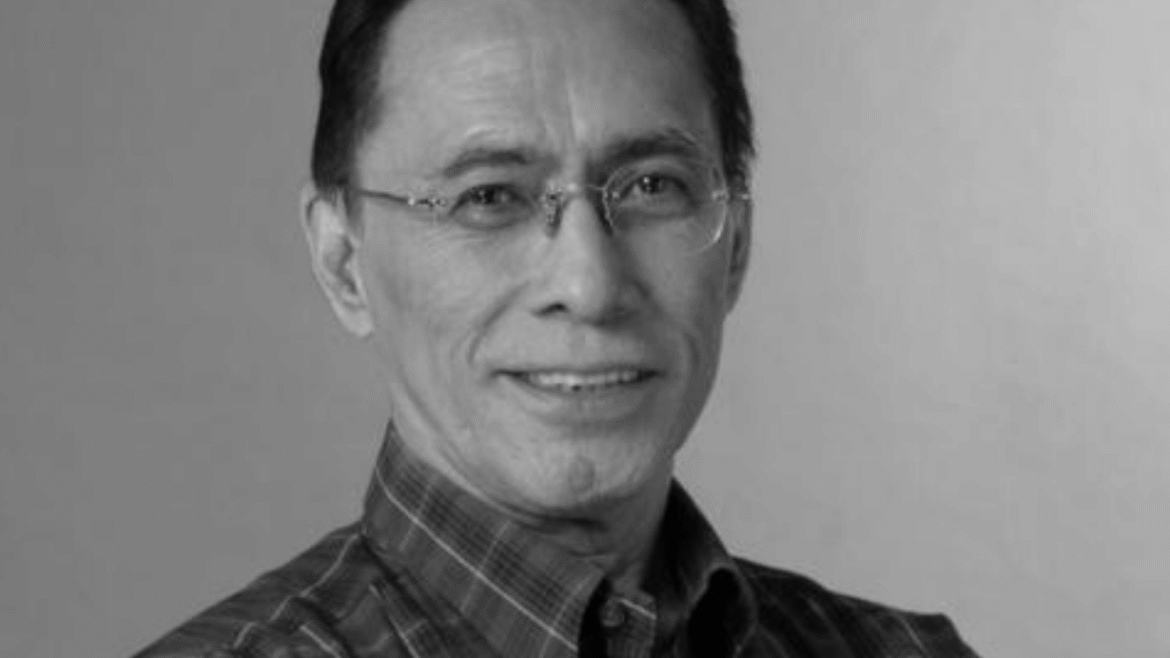
The Philippine arts community mourns the iconic Gawad Urian critic who taught with heart.
“I’ll see you next year.”
That was Tito Genova Valiente’s promise to the students of Sagay National High School, even as he joked that if they didn’t meet again, perhaps they would see each other “a hundred years from now in heaven.”
In 2024, during an event in this Negros Occidental city, the film educator and critic had just learned that the school was naming a section after him under its Special Program for the Arts (SPA), an honor he said he would never forget. “I’m always feeling at home here,” he told them. “This is my second home.”
Two years later, following Valiente’s passing, those words carry a different weight.
‘Anything personal is political’
In the same talk, Valiente opened up about his health, recalling how he had been hospitalized and, after leaving the hospital, asked his doctor if he could travel. The doctor, he said, explained that he needed to undergo a process in which his blood would be drained and replaced as part of his treatment.
Valiente was referring to dialysis, a detail he initially apologized for sharing because it felt too personal. But, characteristically, he turned the personal into a reflection on cinema and society.
He talked about how personal experiences could become political when viewed through film, saying that “anything personal is political” and that the two could not simply be separated.
Then he returned to what mattered to him: the people in front of him.
His death leaves behind not only a body of work in film criticism, anthropology and academe, but also generations of students, filmmakers and cultural workers who remember him for the way he made learning feel like a conversation.
Smart but cozy, friendly and intimate
Lito Zulueta, his colleague from the Manunuri ng Pelikulang Pilipino, which gives out the annual Gawad Urian, remembered Valiente as “not only a dedicated film critic, but an all-around critic of popular culture.” With his background in anthropology, Valiente brought an unusual depth to his cultural writing, infusing his film criticism with insights into society and human behavior.
Yet for all his academic credentials, Zulueta said Valiente was never pompous.
“A conversation with him despite his doctorate is never pompous; it is smart but cozy, very friendly and intimate,” Zulueta told radar Entertainment. “Philippine cultural criticism has lost a most edifying mind and an elucidative presence.”
That warmth was evident in Valiente’s own words. In a video shared by Helen Javier Arguelles, Valiente told his audience that while they might think they were learning from him, he was learning from them, too.
‘I listen to you’
“As a film educator and as a film critic, I listen to you,” he said. “That’s our duty, to listen to you.”
Teaching was not simply about delivering knowledge, said Valiente, but about listening, asking questions and allowing other people’s experiences to reshape the conversation.
Music professor Gerad Paul Elvina, who worked with Valiente at the National Committee on Cinema, also remembered him as someone who recognized the value of work that often happens behind the scenes.
“It’s been an honor and privilege serving with you at the National Committee on Cinema,” Elvina wrote. “Thanks also for appreciating my craft as an audio engineer by advocating it’s equally important to the other departments of film.”
Elvina recalled how Valiente trusted him with the audio restoration of the works of National Artist Nora Aunor, and how his kindness extended beyond their professional relationship.
“Thanks, too, for being like a grandfather to my eldest daughter during our Margaha workshops!” he wrote. “I can never stop thanking you for a lot of things, my family and the film and press industries will surely miss you.”
Arguelles, who remembered seven years of having Valiente as part of the Margaha community, said his presence made them want to become better.
“Truly truly an immense honor having you in our lives, Sir Tito,” she wrote. “You will always be part of our Margaha stories.”
She recalled how he believed in them and made their community his second home.
“Seven incredible years. You are one of the reasons why we always want to be better,” she wrote.
Classrooms made bigger, conversations, richer
That may be Valiente’s most enduring legacy: the ability to make people feel that their stories mattered.
In Sagay, students promised him they would see him again next year. He promised them he would be around.
This time, there is no next year. But there are the classrooms he made bigger, the conversations he made richer, and the people who will carry his lessons with them.
An anthropologist, film critic, educator, journalist and author, Valiente spent his career moving between academe, cinema and cultural journalism. He was a member of the Manunuri ng Pelikulang Pilipino and received the Gawad Alagad ni Balagtas for lifetime achievement in English essay, among other recognitions for his work in Philippine cultural criticism. His legacy is not simply in the awards or titles he accumulated, but in the communities he taught, listened to and inspired.
Perhaps that is the most fitting way to remember Valiente is not for everything he taught, but for how deeply he listened.
READ:

Veteran showbiz columnist, host Jobert Sucaldito dies at 65
Nikko Miguel Garcia
August 2, 2026

Tenor George Sison-Tagle, founder of The Angelos, dies at 50
Top Dagohoy
July 5, 2026
Jose Sison, ‘Ipaglaban Mo!’ host and legal icon, dies at 88
Kiko Escuadro
July 23, 2026


