Architecture and history cited in bid for cultural recognition.
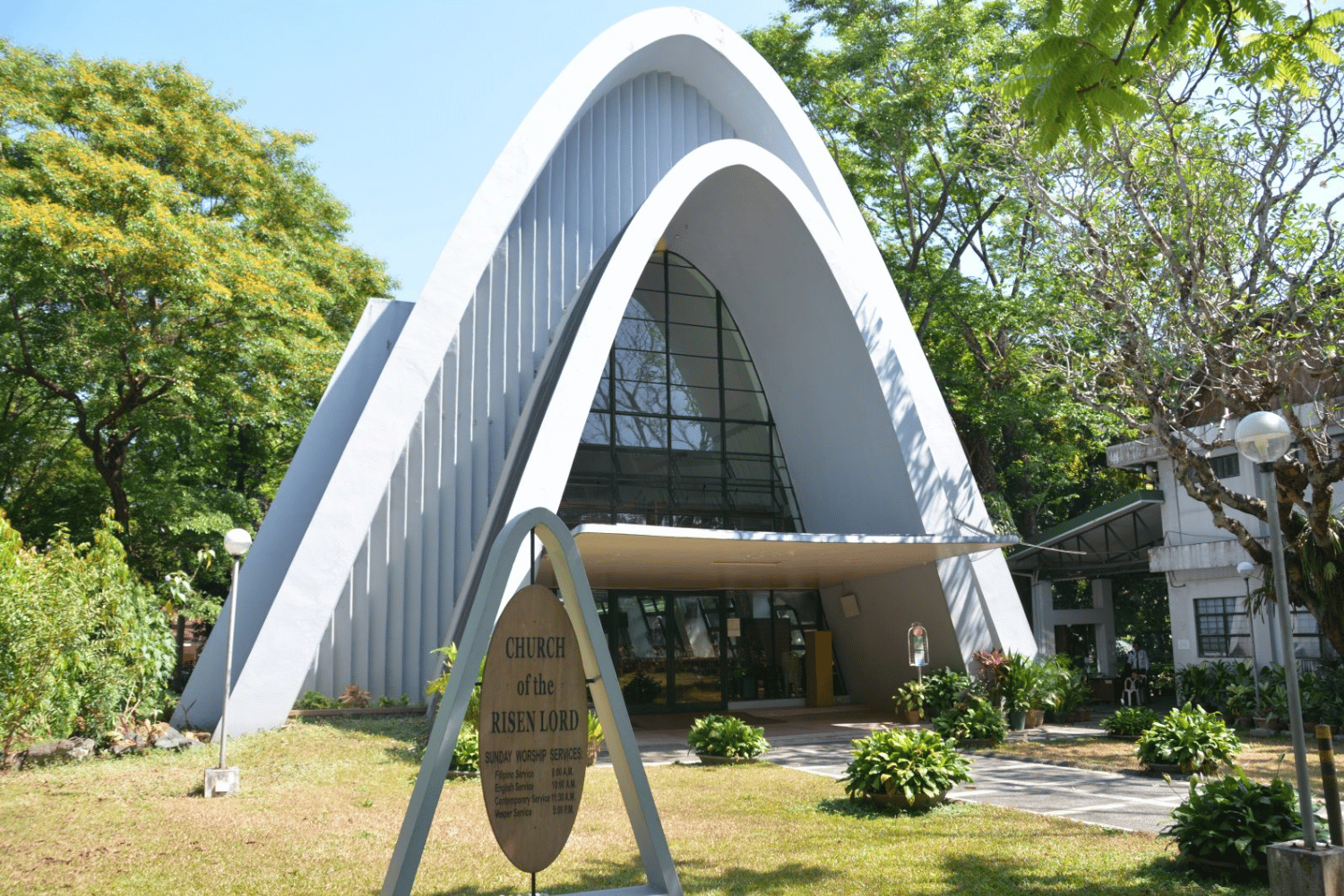
A Christian group is seeking recognition for the Church of the Risen Lord inside the University of the Philippines (UP) Diliman as an Important Cultural Property (ICP), citing its architectural excellence and historical significance.
The National Commission for Culture and the Arts (NCCA) announced the petition on October 19, inviting public comments until November 9. Government agencies, academic institutions, civil groups, and private individuals are welcome to submit arguments for or against the petition.
The petition was submitted by UP Christian Ecumenical Ministry Inc., which runs the church. The group cited four reasons for the church’s proposed designation, centered on the structure’s architectural significance and role in the university’s community and history.
The Church of the Risen Lord, located inside the UP Diliman campus in Quezon City, spans roughly 400 square meters and prominently features a triangular white structure. The site hosts worship services and community activities for a wide range of groups inside and outside the university.
The structure was inaugurated in 1956 and designed by architect Cesar Concio, UP’s first university architect. Concio was also one of the lead architects behind the Makati City central business district and designed the Insular Life building along Ayala Triangle.
In its petition, UP Christian Ecumenical Ministry argues that the Church of the Risen Lord is a Modernist architectural work that represents the period in which it was built. In particular, the structure showcases Concio’s interpretation of the Brazilian Tropical Modernism style applied in the Philippine context, with adjustments made to withstand habagat and amihan monsoons while retaining airflow during dry seasons.
Before a property can be formally declared an ICP, the NCCA must submit a technical report scoring it based on specific criteria covering narratives, authenticity, structural integrity, and protection and management plans.
The Church of the Risen Lord received a score of 86.44% and was recommended for ICP status, subject to public comments and compliance with other requirements.
If declared an ICP, the Church of the Risen Lord will be monitored by the National Museum of the Philippines and enjoy certain protections. Republic Act No. 10066, or the National Heritage Act of 2009, protects ICPs against exportation, modification, or demolition.
The Church of the Holy Sacrifice, the Roman Catholic parish also inside UP Diliman and adjacent to the Christian church, was designated an ICP in 2006. The structure features works by five different National Artists, including architectural design by Leandro Locsin, “River of Life” terrazzo flooring by Arturo Luz and Ang Kiukok, a crucifix carved by Napoleon Abueva, and stations of the cross painted by Vicente Manansala.
READ: