The rite of passage dates back to 1450—and its medical framing now still remains non-mandatory.
For generations of Filipino boys, tuli or circumcision has never been a choice—and it’s long overdue to rethink that.
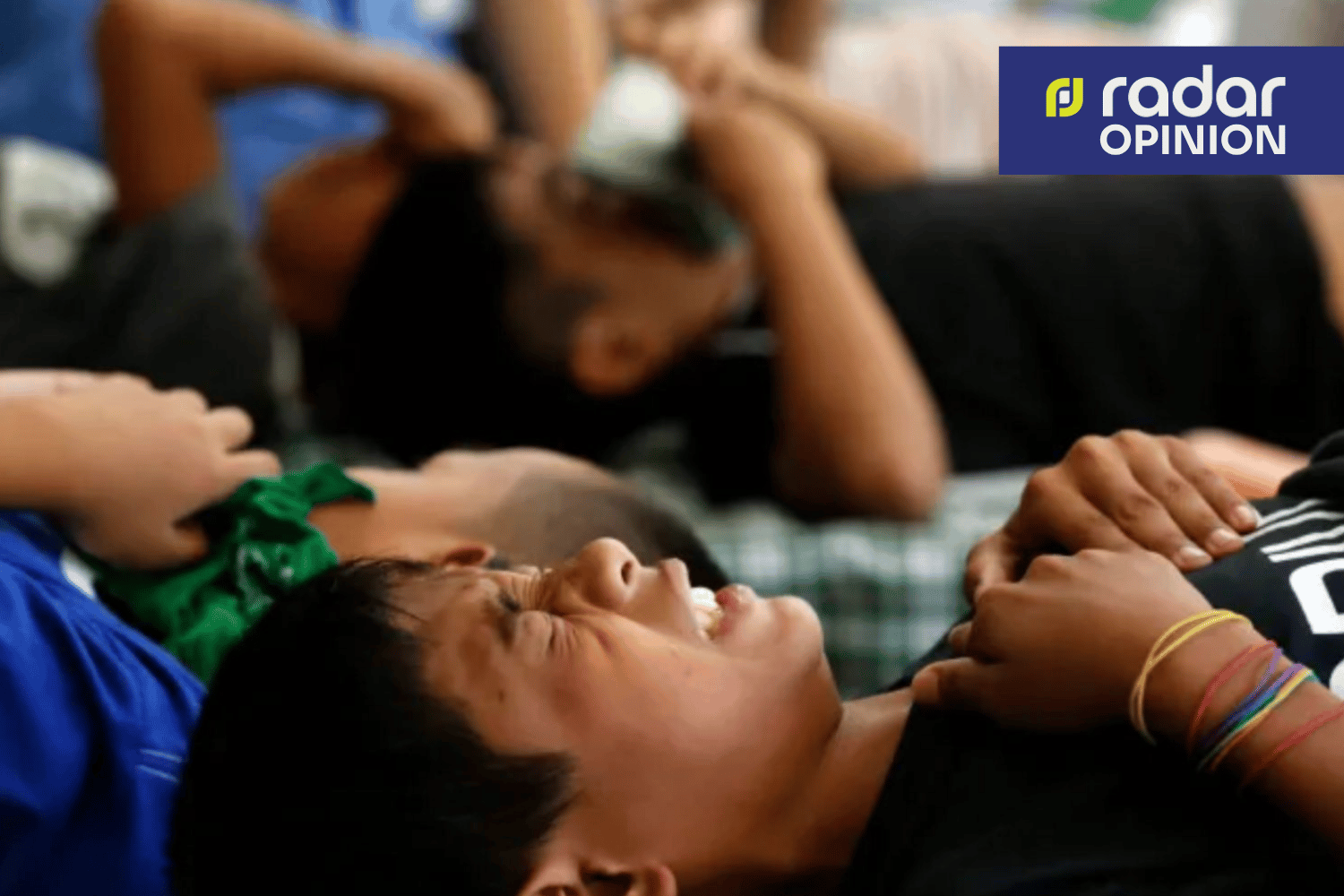
Every April, during the start of “summer break,” boys aged 8 to 12 have their foreskin removed. It’s framed less as a medical procedure and more as a rite of passage tied to masculinity and social acceptance. Saying no is almost unimaginable, as the boy will be mocked not only as supot but also mahina, duwag, and even “bakla.”
In many rural areas, it’s done via the traditional “pukpok.” Boys soak in rivers, chew bayabas leaves, and brace themselves as the manunuli—with no medical background—places a blade against the foreskin on a wooden stump and strikes it. No anesthesia, of course. Afterwards, the chewed bayabas leaves are applied to their wound, and the boys return to the river—as if shedding not only their skin but also childhood itself.
The practice predates precolonial rule. Anthropologist Nestor Castro traces Philippine circumcision to the arrival of Islam in 1450—long before the Spanish occupation in the 16th century. In “Sucesos de las Islas Filipinas,” historian Antonio de Morga documented similar practices influenced by Bornean customs—with Jose Rizal’s later annotations noting the custom persisted even among Christianized communities.
By the 20th century, Americans already observed how deeply embedded the practice had become. In “Circumcision and Flagellation among the Filipinos,” Lt. Charles Norton Barney noted that being uncircumcised was treated as a “defect,” so much so that children “cruelly taunting” those that hadn’t undergone it yet. It also gave rise to the term “supút,” which originally meant “constricted” or “tight” but evolved into an insult aimed at “one who cannot easily gain entrance in sexual intercourse.”
Circumcision has since entered modern medicine. Today, it’s performed by surgeons, urologists, or pediatricians in controlled clinical settings using anesthesia, sterile instruments, and precise techniques—from scalpels and scissors to specialized clamps and rings. Even laser is used to cut and cauterize at once, significantly reducing bleeding while also giving a more “aesthetic” finish.
The methods have changed, but the expectation hasn’t. It’s often justified on medical grounds, particularly hygiene. Smegma or kupal is cited as a concern, along with reduced risks of bacterial infections. Makati Medical Center, citing various global studies, also notes that circumcision may lower risks of urinary tract infections, penile cancer, HIV, and phismosis, or the inability to retract the foreskin (locally referred to as “hindi tagpos” or “hindi sakat).
Still, global medical discourse doesn’t frame circumcision’s benefits as a blanket requirement but a context-dependent intervention. The World Health Organization, for instance, has recommended voluntary medical male circumcision to reduce the risk of HIV infection during heterosexual exposure by 60%.
A 2023 editorial from WebMD notes that proper hygiene and condoms can help reduce significant risks, and being uncircumcised “will make no difference in your genital health and overall quality of life.”
This is reflected in global patterns. According to the World Population Review, only about a third of males are circumcised. It’s common among Muslim and Jewish communities, as well as in parts of the United States, Africa, and Southeast Asia. It remains rare in Europe, Latin America, and most of Asia, while Anglophone countries like Canada, Australia, and New Zealand treat it as a matter of personal preference. (In the Philippines, however, over 90% of males are circumcised.)
If so, what’s often presented locally as a near-universal health necessity is, in reality, a highly uneven practice—shaped more by culture and history than medical consensus.
But the deeper issue isn’t whether circumcision has medical value. It’s how that value is used to justify a practice that most boys have no choice at all. For generations, manhood has been made to hinge on a piece of skin no boy ever chose to lose.