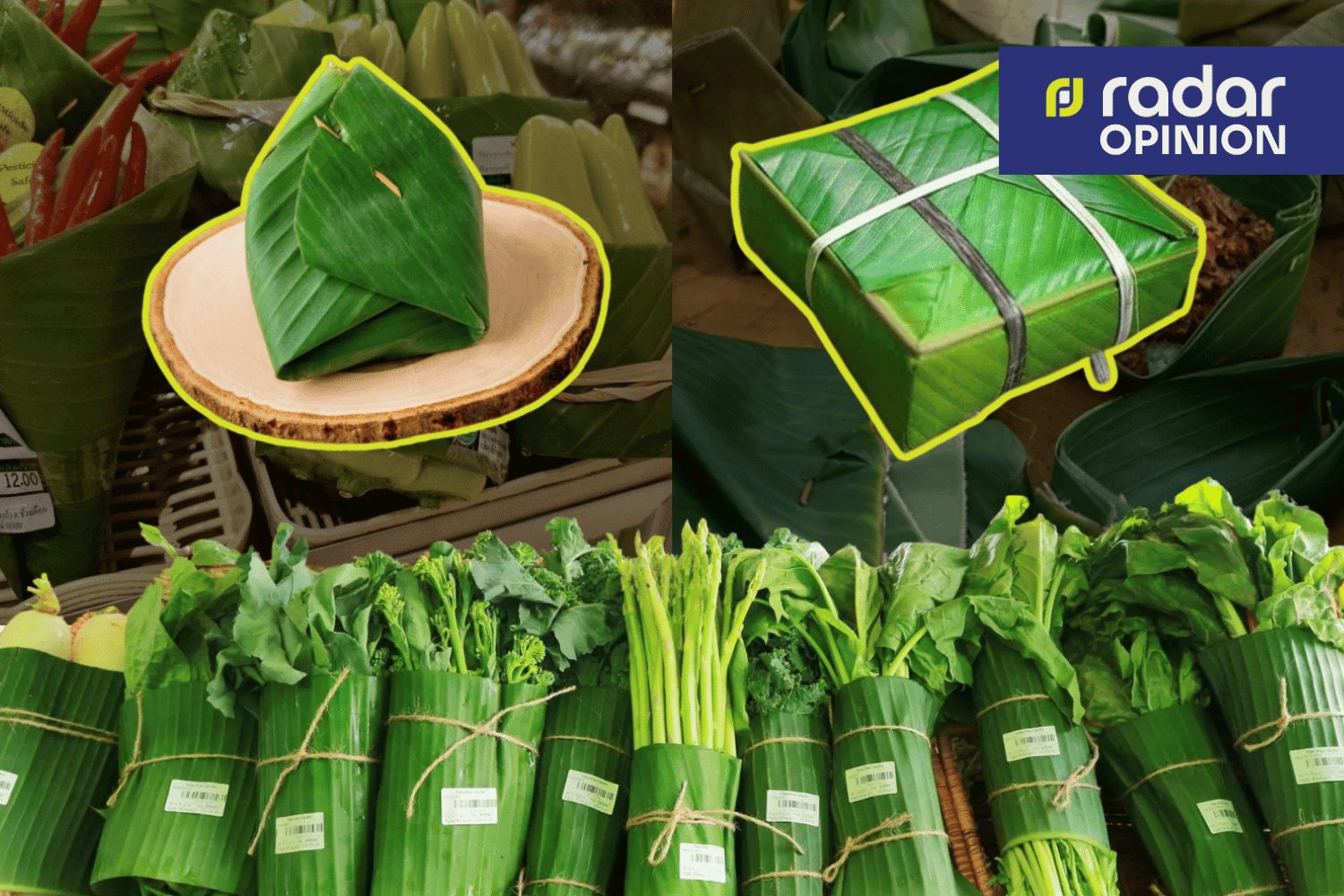
One of the most promising alternatives can be found in Filipino backyards.
You pick up a bundle of pechay at the supermarket. It’s wrapped in a thin plastic sleeve that you’ll probably throw away minutes after getting home.
Now imagine if that same pechay came wrapped in a fresh banana leaf instead.
For many Filipinos, that wouldn’t be a novelty. It would simply be bringing back a practice that has quietly survived in wet markets, roadside stalls, and kitchens across the country.
As plastic waste continues to choke rivers and landfills, banana leaves are emerging as a simple solution hiding in plain sight.
More than just tradition
Banana leaves have always been part of Filipino food culture. They wrap suman, bibingka, and puso, line serving platters, and bundle vegetables in local markets.
They’re also remarkably good at preserving fresh produce.
Their naturally waxy surface locks in moisture, preventing leafy vegetables from drying out. Unlike airtight plastic, banana leaves allow produce to breathe, reducing the trapped humidity that speeds up spoilage. Studies also suggest they contain natural polyphenols with antimicrobial properties that help slow bacterial growth.
Instead of suffocating vegetables, banana leaves help keep them fresh.
Less plastic, more common sense
A plastic wrapper used for a few hours can remain in the environment for centuries. Banana leaves naturally decompose within days or weeks.
They don’t create microplastics, require complicated recycling systems, or leave behind toxic residues.
Replacing even a portion of supermarket plastic packaging with banana leaves could significantly reduce the amount of single-use plastic entering waterways and dumpsites.
Best of all, consumers wouldn’t need to change their shopping habits. The only difference is what goes into the trash afterward.
Good for farmers
Banana plants continuously produce large leaves, making them a renewable resource in a country where bananas grow almost everywhere.
Selling leaves can provide farmers with an additional source of income beyond the fruit itself. Preparing them for packaging requires little more than cleaning, trimming, and proper sanitization—far less energy than manufacturing plastic packaging.
It’s a local solution built from a local crop.
Asia is already proving it works
Several retailers have already shown that banana leaf packaging can succeed commercially.
Thailand’s Rimping Supermarket drew worldwide attention after replacing plastic wraps with banana leaves tied using biodegradable bamboo strips.
Major retailers in Vietnam, including Lotte Mart, Big C, and Saigon Co.op, soon followed by wrapping herbs, leafy greens, and vegetables in banana leaves instead of plastic.
The Philippines has also seen initiatives from Dizon Farms, while many wet markets have continued using banana leaves without ever calling it an environmental campaign.
Sometimes the most sustainable ideas are simply the ones we never abandoned.
The challenges are real—but solvable
Banana leaves still need proper cleaning and sanitization before they can be used commercially. Their varying sizes also make automated packaging more difficult, while fresh leaves require a reliable supply chain.
These are practical hurdles—not impossible ones.
The search for sustainable packaging often revolves around futuristic materials and expensive innovations.
Yet one of the most promising alternatives has been growing in Filipino backyards all along.
Perhaps the next time you buy vegetables, the greenest choice won’t be what’s inside the package.
It will be the package itself.
READ: