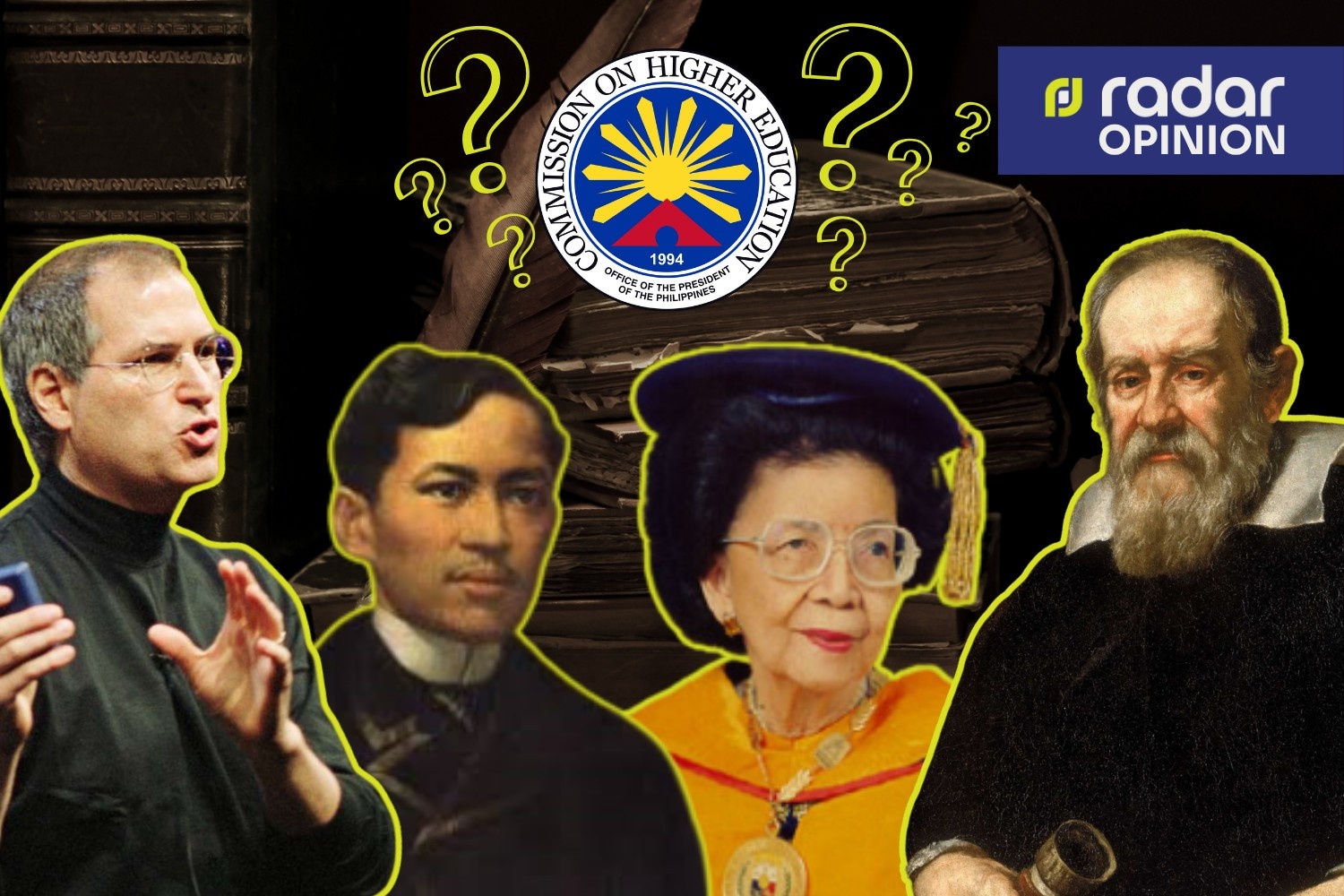
From Galileo to Rizal to Jobs, the humanities have long complemented science.
The Commission on Higher Education proposes to cut general education units in college to produce more “job-ready” graduates. But it may only produce more graduates who are narrowly trained—and miseducated.
For AY 2027–2028, CHED plans to set GE units at a minimum of 18. Of these, 15 will be “core” subjects: Professional Communication, Global Trends and Emerging Technologies, Data Evidence and Ethics in a Knowledge Society, Rizal and Philippine Studies, and Labor Education. The remaining three will be “institutional” subjects. Colleges may expand GE offerings up to 36 units.
In effect, the humanities—philosophy, ethics, literature, art appreciation, and history—will no longer stand as independent disciplines but be integrated into broader subjects.
It’s a double whammy. As CHED trims general education in college, the Department of Education is doing the same in senior high school.
For AY 2026–2027, SHS core subjects are reduced from 15 to five: Effective Communication, Life and Career Skills, General Mathematics, General Science, and Pag-aaral ng Kasaysayan at Lipunang Pilipino. By Grade 12, students are pushed toward specialization or work immersion depending on track—”Academic” for college, or “Technical-Professional” for immediate work.
Authorities have long promoted so-called “outcomes-based education,” where success is measured by how quickly graduates can transition into the workforce. It sounds practical until education is reduced to employability and nothing more. We might as well hire robots. It’s the age of AI, after all.
If CHED’s ambition is to produce more scientists, engineers, doctors, and executives, its understanding of education appears shallow. As history shows, the world’s most consequential minds were shaped by the very humanities CHED now seeks to sideline.
Galileo’s mastery of chiaroscuro and perspective helped him map the moon’s mountains, craters, and earthshine through telescopic observation.
Alexander Fleming practiced painting with bacteria-colored agar, sharpening his eye for patterns. Soon, he noticed his petri dish’s staphylococci dying to penicillium—and ultimately discovered penicillin.
J. Robert Oppenheimer led the development of atomic bomb and later, he revisited “Bhagavad Gita” and its teachings on dharma to confront his creation’s moral consequences—advocating against nuclear weapons.
The same pattern is evident in the Philippines.
Jose Rizal studied ophthalmology in Europe, not for profit but to operate his mother’s eye himself. During his exile in Dapitan, he became a general practitioner for the poor—while also building schools, water systems, and agricultural reforms shaped by Enlightenment thought.
Maria Orosa invented banana ketchup to reduce dependence on American imports. She also developed fruit canning techniques and a palayok oven for households without electricity.
Fe del Mundo integrated local practices like hilot into pediatric care—and designed a low-cost, non-electric bamboo incubator for rural communities.
Eduardo Quisumbing authored the seminal, 1,000-page “Medicinal Plants of the Philippines”—drawing from colonial records, missionary accounts, travel writings, and practices of albularyos and herbolarios.
Angel Alcala championed marine conservation grounded in stewardship—shaped by moral and cultural perspectives on nature.
Juan Flavier used creative communications in public health campaigns as DOH secretary. As a memoirist, he documented impoverished provinces’ health struggles in his “Barrios” books. As a senator, his landmark legislations included the Traditional Medicine Law, the Poverty Alleviation Law, Clean Air Act, and the Indigenous People’s Rights Act.
In the modern digital era that CHED seeks to prepare students for, curiously, many influential tech leaders are deeply shaped by the humanities.
Steve Jobs credited his calligraphy subject in college for shaping Apple’s typography. His minimalist principle draws from Pablo Picasso’s “The Bull,” Leonardo da Vinci’s “Simplicity is the ultimate sophistication” belief, the Bauhaus school’s functional design, and Japan’s shin-hanga movement.
Susan Wojcicki used her history and literature background to shape YouTube as a storytelling and education platform.
Daniela Amodei, a literature major, has noted that “things that make us human will become much more important” as AI begins doing more, including her Anthropic.
Stewart Butterfield, who has a master’s in philosophy, has three Cs as Slack’s business ethos: clarity, culture, and communication.
Brian Chesky, an industrial design graduate, centered Airbnb on trust, storytelling, and human experience.
These are only a few examples, but it’s so clear: The humanities complement science and technology.
One may wonder what CHED officials actually learned in school.